teamspace

Receive, check and post incoming invoices digitally.

Supplier invoices arrive by email, by upload or as an e-invoice, pass through approval and end up where they belong: on the project and in your accounts. teamspace manages them in the enterprise edition, without a second system.
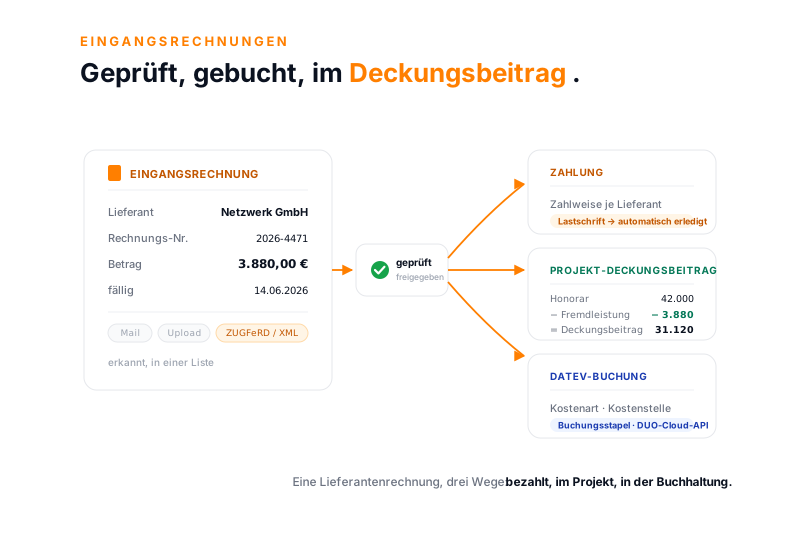
teamspace incoming invoices as a light concept illustration: on the left an approved supplier invoice with amount and due date, from there three arrows lead into the cards payment, project contribution margin and DATEV posting.

The goal

Every invoice checked, every cost on the right project.

Anyone who manages incoming invoices wants to know one thing above all: which supplier invoices are open, whether they have been checked and what they cost. No receipt is left lying around, no payment goes through unchecked.

For project-based professional services firms there is a second goal on top of that. Every cost belongs with the project that caused it. Only then does the contribution margin tell the truth, and only then do the receipts reach accounting already checked. teamspace runs this route from the inbox to the posting in one place.

The invoice inbox today

Who has the invoice, and has it been checked yet?

  • One invoice arrives by email, the next on paper, the third as XML.
  • Who has already checked the receipt is something nobody quite knows.
  • At month-end somebody gathers the open receipts for the accountant.
  • Which cost belongs to which project appears in no report.
  • Early-payment discounts lapse because approval sat in a mailbox too long.
  • The receipts are spread across four mailboxes, and the overview is missing.

A digital invoice inbox means one entry point, one list, one traceable route.

The route of an invoice

You manage incoming invoices in five steps.

From arrival to posting, teamspace runs every supplier invoice in one place. Each receipt carries its status visibly, and nobody has to ask where it currently sits.

  1. 1

    Receive the invoice

    Supplier invoices arrive through a central inbox, by upload, as a photo from the web app, or as ZUGFeRD and XRechnung. Every channel collects in one arrivals list.

  2. 2

    Capture the data

    teamspace reads supplier, invoice number, amount, tax rate and due date from the receipt. For e-invoices straight from the embedded XML, for scans through the text recognition you can switch on.

  3. 3

    Check and approve

    Where an approval workflow is attached to the receipt, it cannot be created directly, only submitted for review. The designated reviewer is notified and approves, and who approved what and when stays traceable.

  4. 4

    Assign it to the project

    The approved invoice is assigned to its project and counts there as third-party costs. Only then does the contribution margin stand complete beside fees, hours and travel expenses.

  5. 5

    Pay and post

    teamspace remembers the payment method per supplier, and the checked receipt goes into the financial accounts through the DATEV interface. In GoBD mode it is preserved audit-proof for ten years.

Arrival

Every channel lands in one list.

Supplier invoices come in on four routes: by email to a central inbox, by upload, as a photo through the installable web app, or directly as ZUGFeRD and XRechnung. teamspace collects them in one list.

  • The central inbox pulls invoices in automatically from one address.
  • Paper receipts are photographed by staff with the web app, or the PDF is dragged and dropped into the system.
  • E-invoices are recognised by teamspace from the embedded XML and imported with one click.

Managing the invoice inbox centrally means every receipt sits in one place instead of four mailboxes, sortable by arrival, supplier or status.

See digital receipt capture

Recognition

Recognise the fields instead of typing them.

You capture incoming invoices in teamspace without typing them out. From the arriving receipt the system reads the data that matters for the check and the posting: supplier, invoice number, amount, tax rate and due date.

  • For ZUGFeRD and XRechnung the embedded XML is processed directly, with no text recognition.
  • For scanned or photographed receipts the OCR can be switched on through the Google Vision API. It is deactivated by default and needs written approval of the subprocessor.
  • The recognised supplier is matched to the contact in the system.

The invoice then stands ready with its values before anyone sends it off for review.

More on e-invoicing

Three routes

An incoming invoice does not end at the export.

Once the receipt is checked, it works in three places at once: it gets paid, it charges the contribution margin of its project, and it goes to the accountant as a posting.

Incoming invoice approved

Netzwerk GmbH

No. 2026-4471 · 3,880.00 € · due 14 Jun

Payment
Method direct debit
Status auto-settled
Project margin
Assigned to Berger engagement
Counts as third-party costs
DATEV posting
Cost centre pre-filled
Hand-off DUO cloud API

Approved once, and payment, project margin and the posting follow on their own.

What you gain

Three gains from a digital invoice inbox.

Running supplier invoices digitally gains you more than a tidy mailbox.

No receipt goes missing

  • Every channel converges in one arrivals list.
  • Each receipt carries its status, visible to everyone authorised.
  • Nothing sits forgotten in a private mailbox.

Every cost hits the right project

  • An incoming invoice can be assigned to a project.
  • As third-party costs it sits in the contribution margin beside fees and hours.
  • Reportable by supplier, category or product type.

Checked when it reaches your accountant

  • Only after approval does the receipt go into the posting.
  • The DATEV interface lands it in the financial accounts.
  • In GoBD mode it is preserved audit-proof.

Approval

Checked first, posted after.

Incoming invoices must not wander into accounting unchecked. In teamspace you attach an approval workflow to the receipt. While it is active, the receipt cannot be created directly, only submitted for review.

  • Reviewers and conditions are defined up front in the configuration.
  • The designated reviewer is notified, checks the receipt and approves it.
  • Through the "Next steps" module follow-up tasks arise on validation, such as an open point or an email.

That keeps it traceable who approved what and when, before the payment runs.

The check

You check an incoming invoice on three levels.

Incoming invoices are checked on the facts, on the arithmetic and on the law. Only when all three levels hold does the receipt go into payment.

On the facts

  • Was the service actually delivered?
  • Does it match the purchase order or the order?
  • Do the quantity and the service period fit?

On the arithmetic

  • Are unit prices and totals added up correctly?
  • Are the tax rate and the tax shown correct?
  • Do net, tax and gross match one another?

On the law

  • Are issuer and recipient named in full?
  • Are the invoice number, the date and the tax or VAT ID present?
  • Are the type and quantity of the service stated?

“We mostly work with the budget column.”

brandwerk reads off the budget column what a project has cost so far: logged hours beside the incoming invoices from subcontractors.
brandwerk consulting group

Controlling

Every cost lands in the contribution margin.

This is where teamspace parts company with a plain receipt archive. An incoming invoice can be assigned to a project and counts there as third-party costs, beside the fees, the logged hours and the travel expenses. That is how a complete contribution margin comes about.

  • Report on costs by category, supplier or product type.
  • Cost type, cost centre and cost unit are pre-filled by a rule and made filterable in lists.
  • The subcontractor on the incoming invoice appears as a cost item on the right project.

Anyone who bills projects sees the margin honestly only once the third-party costs sit inside it.

No obligation

How do your supplier invoices arrive today?

Tell us about your invoice inbox, and we will show you the route from the receipt to the posting in teamspace.

Get your answers

Payment

teamspace remembers how you pay.

Some suppliers you always pay the same way. teamspace remembers the payment method per supplier and sets the payment to settled automatically as soon as it falls due.

  • Invoices settled by direct debit count as paid without a further click.
  • The online banking interface reconciles incoming payments daily; it checks what arrives and triggers no payments itself.
  • Open amounts stay visible in the list until they are settled.

That saves the small handling steps which add up to half a day over a month.

To accounting

Approved, posted, safe for ten years.

teamspace hands checked incoming invoices to the financial accounts, with a posting record made up of account, cost centre, cost unit and tax key.

  • Through the DATEV-certified interface incoming invoices go straight to DATEV Unternehmen online as a cloud API, one posting batch per client, with no CSV file.
  • For Lexware, Sage and SAP there is no dedicated connector; they take the data over standard exports or the REST API.
  • In GoBD mode, which 5 POINT activates on request, approved receipts are preserved audit-proof for ten years.

Nobody sends files back and forth, and the posting sits with the accountant.

More on the DATEV export

Use cases

What else hangs off the receipt process.

The invoice inbox shares receipts, interfaces and the hand-over to accounting with these areas.

Digital receipt capture

Capture receipts by photo, upload or email and file them centrally.

Learn more

DATEV export

Posting records with account, cost centre and tax key to DATEV.

Learn more

E-invoicing

Receive and create ZUGFeRD and XRechnung, to EN 16931.

Learn more

Order billing

Bill fixed price, time and materials and retainers on the same order.

Learn more

Travel expenses

Capture receipts, check them and pass them on to the client.

Learn more
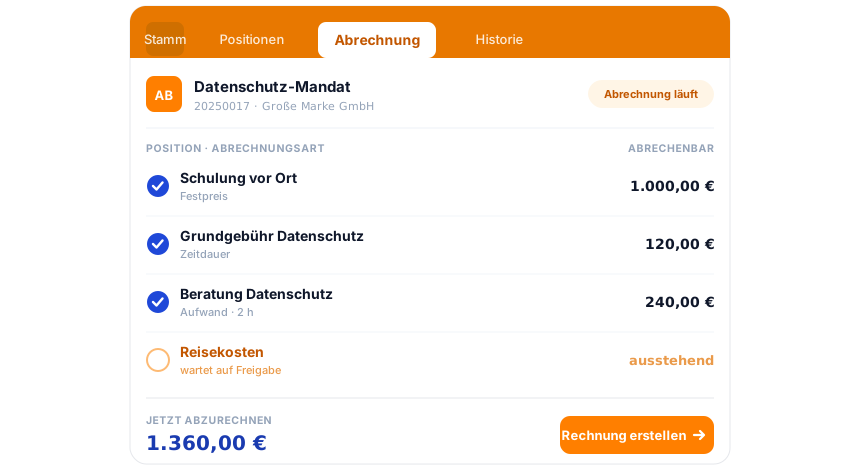
teamspace invoicing software: an order on the billing tab, three items billable with a blue tick, the travel expenses item waiting for approval, below it the total to bill now and the action create invoice.

Part of the invoicing software

Incoming and outgoing in one billing tool.

Checking and posting supplier invoices is one side. Quotes, orders and outgoing invoices are the other. In teamspace both run through the same billing tool, with the DATEV hand-over and GoBD mode you can switch on. How it all fits together is shown by the invoicing software overview.

To the invoicing software

What this is about

What an incoming invoice has to contain.

An incoming invoice is a supplier or contractor invoice that a company receives, checks and pays. For the recipient it is a liability, the counterpart to the outgoing invoice with which it bills its own services.

For an arriving invoice to be paid and the input tax to be reclaimed, fixed details belong in it: name and address of issuer and recipient, invoice number and date, tax or VAT ID, service period, type and quantity of the service, plus net, tax and gross. For small amounts up to 250 euros a few mandatory details suffice.

The check runs on three levels: on the facts (does the service match the order?), on the arithmetic (are amounts and tax rates correct?) and on the law (are all mandatory details there?). teamspace maps this route from arrival through approval to the posting digitally, and processes the data exclusively in the EU, in an ISO-27001-certified data centre in Frankfurt am Main, GDPR-compliant with a data processing agreement as standard. The contracting party is 5 POINT AG, a German public limited company. Hours are logged in time tracking, the project takes shape in project management, and billing happens in the invoicing software.

Introductory call

We will take a look at your invoice inbox.

Show us how supplier invoices arrive today. In twenty minutes we work out what can be mapped in teamspace and what the hand-over to your accounting looks like.

Frequently asked questions about incoming invoices

How do you manage incoming invoices properly?
Managing incoming invoices means running every supplier invoice in one place, from its arrival to the posting. The route runs over five steps: receive the invoice, capture its data, check it on the facts, the arithmetic and the law and approve it, assign it to the project that caused it, then pay and post it. What matters is that every arrival channel converges in one list and that each receipt carries its status visibly, so that no invoice is left sitting in a private mailbox.
How do you check an incoming invoice?
On three levels. On the facts: was the service delivered, and does it match the order? On the arithmetic: are amounts, tax rates and totals correct? On the law: are all mandatory details present, meaning issuer and recipient, invoice number, date, tax or VAT ID, service period, plus net, tax and gross? For small amounts up to 250 euros a few mandatory details suffice. In teamspace you attach an approval workflow to the receipt for this, so that it reaches accounting only after the check.
How do incoming invoices reach the system?
On four routes: through a central email inbox, by manual upload, by photo through the installable web app (PWA), or directly as ZUGFeRD or XRechnung. All receipts collect in one arrivals list.
How does the recognition of the receipt data work?
For ZUGFeRD and XRechnung the embedded XML is processed directly, with no text recognition. For scanned or photographed receipts an OCR can be switched on through the Google Vision API. It is deactivated by default and is activated only after written approval by the client of the subprocessor. Supplier, invoice number, amount, tax rate and due date are recognised.
How does the approval of an incoming invoice work?
You attach an approval workflow to the receipt. While it is active, the invoice cannot be created directly, only submitted for review. The designated reviewer is notified, checks and approves. Which reviewers and conditions apply is defined up front in the configuration; through the "Next steps" module follow-up tasks arise automatically.
Can I assign incoming invoices to a project?
Yes. An incoming invoice can be assigned to a project and counts there as third-party costs, beside fees, logged hours and travel expenses. That is how a complete contribution margin comes about. Costs can also be reported on by category, supplier or product type.
How does the hand-over to DATEV work?
Through the DATEV-certified interface to DATEV Unternehmen online (DUO) in the enterprise edition. Incoming invoices go straight into the financial accounts as a cloud API, one posting batch per client, with no CSV export. For Lexware, Sage or SAP there is no dedicated connector; the exchange runs over standard exports or the REST API. More on DATEV export.
Are the receipts kept audit-proof?
With GoBD mode activated, approved receipts are preserved for ten years and can no longer be deleted technically. Only 5 POINT activates the mode, at the customer's request. They are kept in certified data centres in Frankfurt am Main.
Is incoming invoice management included in every edition?
Digital receipt capture with incoming invoices, the DATEV interface and the online banking interface belong to the enterprise edition. In the introductory call we work out which edition fits your inbound workflow.