
Tasks in lists and email
- The state sits in a column, easy to miss
- Nobody sees at a glance what is running now
- Bottlenecks only show when it is too late
- Everyone keeps asking for the current state
A kanban board shows work as cards in status columns. A card moves from To do to Done, the state is visible to the whole team, and wherever cards pile up, the bottleneck shows early. In teamspace you run a board for tasks, tickets or a whole project. Part of the teamspace cloud software.
Where it fits
The principle
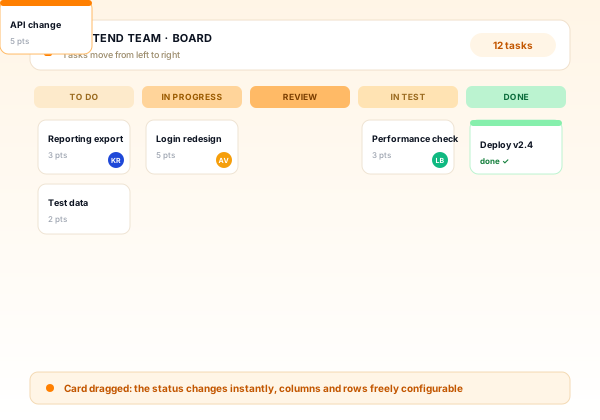
Every task is a card and sits in the column of its status. Whoever moved it forward drags it one column to the right, from To do through In progress to Done. So everyone sees where the work stands and where it is stuck.
ready to start
someone is on it
API change
5 points · A. Vogt
waiting for review
being checked
finished
A task moves visibly from left to right.
How many cards sit in a column at once, the team sets itself.
Layout
You set up a board to fit how you work, not the other way round. What separates a column and what a row bundles is yours to decide.
So a wall of columns becomes a board that shows your team's reality, not someone else's scheme. The same axis logic carries every board in teamspace, from the kanban board to a freely configured pinboard.
Feature set
Classic and agile
Nobody has to choose between classic and agile. The planned project in the Gantt and the work on the board hang on the same element: the work package.
Whoever keeps cards and hours in two worlds knows the collateral damage: cards without an hour link, hours without a card, corrections at month-end. Here it is one item.
Background
Behind the scenes teamspace knows two ways to read a card. Which one fits depends on the use case.
Show the list as a board. A set of work packages can be shown as a kanban or scrum board instead of a table, with the columns standing for status. Here the card is the work package itself: drag it into another column and you change the work package's status. It stays the same entity, only shown differently.
The board as its own entity. Alongside that, you can create a board that carries its own cards, where each card points to another element, for example a ticket. Now the card is the thing being moved: it runs its own status, independent of the linked item. On a candidate board, cards are linked to the application tickets. The ticket carries the communication and stands at, say, "answered"; the card carries the selection and stands at "shortlisted" or "schedule interview". The two statuses run separately.
When it is about the status of the work itself, you show the list as a board. When a process of its own should run over the linked items, you create a board with its own cards. teamspace can do both.
“We mostly work with the budget column.”

Method
A kanban board is a method for making work visible and limiting its flow. Cards stand for tasks, columns for the state of work. A card moves from left to right until it is done. The principle began in the 1940s at Toyota, where "kanban" was the signal card for material being pulled in.
Four principles carry the method, whatever the tool:
In teamspace you map these principles through freely configurable columns and statuses. Running a board online has two hard advantages over a whiteboard: distributed teams work on the same state, and every move stays traceable.
How a board looks depends on the team. Four typical configurations, each with its own columns and rows.
Development and maintenance on one board
Tickets as cards, without a second tool
From briefing to client sign-off
One pipeline per role
Overview
A board only becomes a steering tool once everyone sees, without asking, where a task stands. That is exactly what the shared view delivers.
So the board is no weekly snapshot but a view that runs along with the work.
Next step
In 20 minutes we walk through which items belong on a board and how columns and rows map your status flow. You get a clear first read on whether teamspace fits how you work.
In a few steps
From an empty board to a running wall of columns is five steps, most of them one-off.
Pick a type: Kanban, Scrum or pinboard. Each type starts with its own statuses and can be freely adjusted afterwards.
Adjust statuses and decide what separates a column: status, owner, element type or group.
Define the rows, for instance per person or client. Colour cards by status and choose the card size.
Fill the board automatically or by hand from a project, a directory or a person, or place tickets and work packages straight on.
Everyone moves their cards through the statuses with the mouse. Hours are logged on the linked work package.
More from project management
The board is one of several views on the same project. These areas go deeper into specific questions.
Sprint backlog and status columns for the sprint rhythm.
Learn moreTasks with owners and due dates as a card source.
Learn moreWork packages that cards point to and book hours onto.
Learn moreMany projects in parallel, each with its own boards.
Learn morePlan vs actual and margin from the logged hours.
Learn moreWikis and attachments, linked to the cards on the project.
Learn moreChoosing a method
Kanban and Scrum are both agile methods; they differ in rhythm. Which one fits depends on the kind of work, and nobody has to commit for good.
You reach for Kanban when the work comes in continuously and is hard to plan. A support team cannot freeze a two-week plan when a critical incident lands today; it pulls the next card as soon as one frees up. When priorities turn faster than a sprint lasts, when tasks vary widely in size, or when the fixed sprint dates cost a small team more than they return, the open flow is the calmer route. Service, maintenance and operations therefore usually run better with Kanban.
A scrum board pays off where a product takes shape in plannable steps and a fixed delivery rhythm helps. What both boards deliberately do not bring are sprint analyses like burndown or velocity; they run freely configurable status columns, not measurement charts. Many teams use both side by side: development in the sprint beat, support in the running flow.
In overview
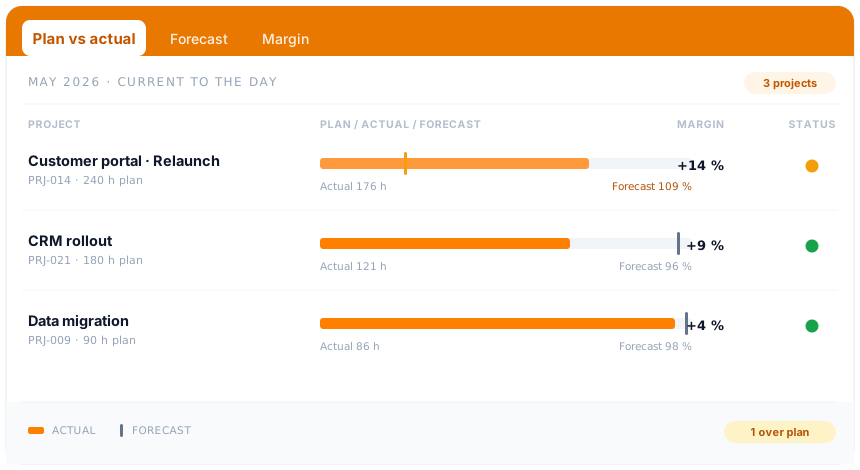
Boards move items in an agile flow. How teamspace plans, steers and bills projects, from plan vs actual through earned value to the invoice from the project, is shown by the project management overview.
To project managementRelated modules
Whoever moves tasks on a board almost always deals with the hour, the invoice and the contact. Here are the shortest routes there.
Hours land on the work package of a card and are the basis for plan vs actual and billing.
Completed tasks become the invoice, with hourly rates, flat rates and billing rules.
Contacts in a sales campaign sit as cards on the board and stay linked to the customer file.
Intro call
You show us your items and your status flow, and we align columns and rows to them. By the end you know whether teamspace fits how you work.