
Meetings in the teamspace calendar
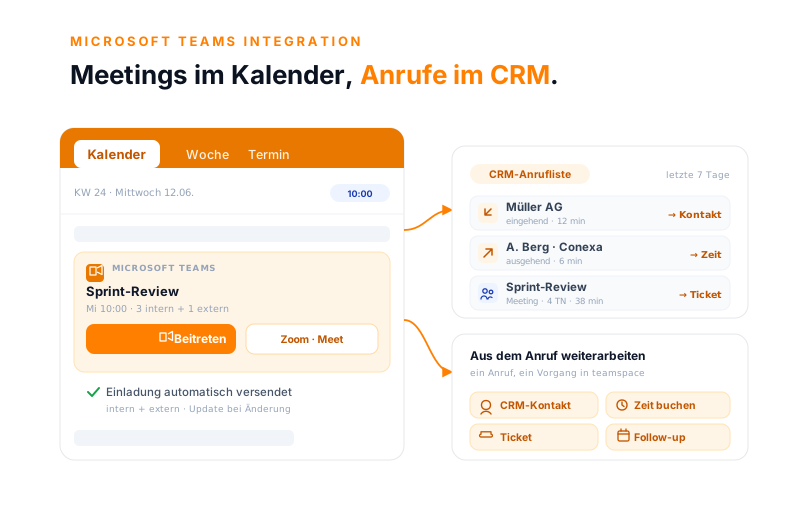
You create Teams meetings straight in the calendar. The invitation goes out automatically to everyone, internal and external alike, and changes are resent.
With the Microsoft Teams integration you create Teams meetings straight in the teamspace calendar, join them with a click and see every Teams call in the call list. A call becomes a CRM contact, a booked hour, a ticket or a follow-up. Included in every edition, with no extra module.
Scope
You create Teams meetings straight in the calendar. The invitation goes out automatically to everyone, internal and external alike, and changes are resent.
The join button sits in the calendar entry. One click opens the meeting, with no jumping between applications.
Every Teams call appears in the call list, with direction, duration and main contact. From there every call carries on into your processes.
Appointments
You create a Teams meeting where your appointments already sit: in the teamspace calendar. A tick turns the appointment into a Microsoft Teams meeting, and the rest works like any other entry.
The meeting is created in a single step, rather than being maintained twice between calendar and Teams.
Joining
When a Teams meeting sits in the calendar, a join button appears on the entry. One click opens the conversation, and you stay in the logic of your teamspace day.
Whether Microsoft Teams or another tool: the way into the meeting runs through the calendar entry.
From every Teams call you trigger a series of follow-on actions in teamspace. That way communication hangs on your processes, rather than ending up in a phone log.
A Teams call does not stay in the phone log; it becomes a process in teamspace.
“Our staff appreciate how simple the system is.”

Overview
As soon as the connection is active, you see in the sidebar all the Teams calls and meetings of the last seven days that you took part in. Each row shows direction, duration and main contact.
That turns a fleeting call history into a list you can keep working from.
Day to day
Three things by which the Microsoft Teams integration can be measured. All three run where the work already sits.
Feasibility
15 minutes along your Teams workflow.
You show us how meetings and calls happen at your firm today. We show how appointments and calls come together with contacts, hours and tickets. After that you know whether the connection fits your setup.
More from teamwork
The connection is part of the teamwork software. These areas border on it directly and share the same user groups.
The team's appointments, availability and meetings in one view.
Learn more1:1 and group chat in the system, Microsoft Teams compatible.
Learn moreAn agreement becomes the open item with owner and deadline.
Learn moreStore shared files versioned, on the project and the client.
Learn moreWhat gets asked often belongs versioned in the wiki.
Learn moreFor topics that run longer, with polls and editing.
Learn moreDefinition
The Microsoft Teams integration connects Microsoft Teams with teamspace. Appointments, joins and calls take place in teamspace, while Microsoft Teams handles the communication. The connection is optional and is activated by the customer with their own Microsoft account.
In practice this means: Teams meetings start in the teamspace calendar, joining works with a click, and Teams calls appear in the CRM call list. From there every call can be linked with a contact, a booked hour, a ticket or a follow-up.
A chat sync of the Teams channels is deliberately not provided. The familiar Microsoft 365 world stays, and the link to projects, clients and tickets is made in teamspace. For professional services firms what counts most is that conversations do not sit beside the work, but on it.
At a glance
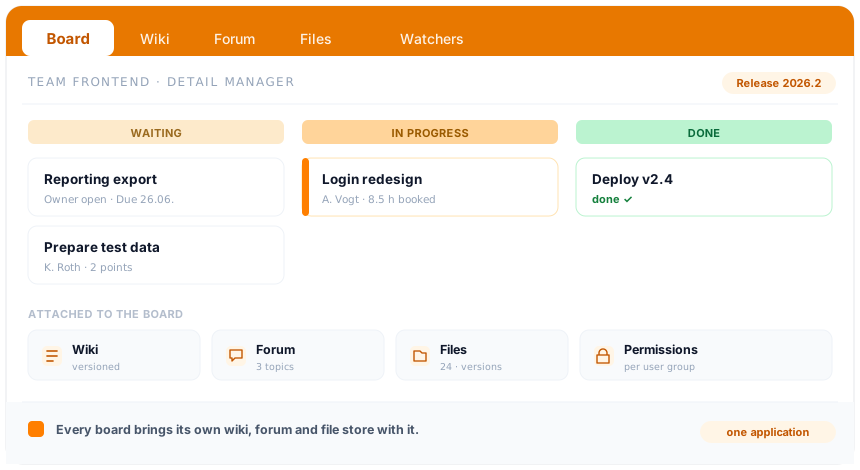
Appointments and calls are one thing, the rest of the collaboration another. How teamspace bundles boards, wiki, forum, team calendar and chat in one application, each board with its own wiki, forum and file drawer, is shown by the overview of the teamwork software.
To the teamwork softwareData protection
The connection is optional. The customer activates it per user via the Microsoft login and connects their own Microsoft tenant with teamspace. Calendar and call data thus flow into the customer's tenant; here 5 POINT is not a sub-processor, but only provides the connection.
This leaves untouched how teamspace processes your data: still exclusively in the EU, in an ISO 27001 certified data centre in Frankfurt am Main. Anyone switching the integration on assesses the additional data flow to Microsoft for themselves; teamspace itself keeps no US data flows in the mandatory data path. The contracting party is 5 POINT AG from Darmstadt.
Related modules
Whoever is on a call or holding a meeting almost always talks about a project, a client or a booked hour. Here are the shortest routes there.
A meeting becomes project work: structure, phases and planned-versus-actual, up to date.
The call lands on the contact: cases, history and call lists in one place.
A call becomes the booked hour: billable or internal, kept apart.
In many firms Microsoft Teams is the central tool for meetings and calls. When appointments and calls sit in one tool and projects, hours and tickets in another, double maintenance arises. The Microsoft Teams integration connects both worlds: meetings start in the teamspace calendar, joining works with a click, and Teams calls appear in an overview from which contacts, times, tickets and follow-ups can be linked.
In the teamspace calendar you create Microsoft Teams meetings directly. The invitation goes out automatically to all participants, internal and external. If you adjust the appointment later, for instance the time, description or participants, everyone receives an updated invitation, without you switching between applications.
As soon as the mouse hovers over a calendar entry with a Teams meeting, a join button appears. One click opens the meeting, and you stay in the logic of your teamspace day.
Instead of a Microsoft Teams URL you can also add Zoom, Google Meet or other meeting links in the calendar entry. Joining works the same way through a click in the teamspace calendar.
As soon as your Microsoft Teams connection is active, you see in a sidebar all the Teams calls and meetings of the last seven days that you took part in, with direction, duration and main contact. Through the CRM module you filter precisely: calls only, meetings only, as organiser or as participant.
For each Teams call teamspace offers a series of follow-on actions with which you connect the communication to your processes:
The Microsoft Teams integration is optional and is activated by the customer with their own Microsoft account. Calendar and call data thus flow into the customer’s Microsoft tenant; here 5 POINT is not a sub-processor, but only provides the connection. The processing of teamspace customer data remains untouched by this and still takes place exclusively in the EU, in an ISO 27001 certified data centre in Frankfurt am Main.
Wondering whether the Microsoft Teams integration makes sense in your organisation? In the 15- to 30-minute call we look at your Teams workflow, the permission logic and which follow-on functions are relevant for you.
Intro call
We discuss your Teams workflow and check which follow-on functions count for you. You get an honest assessment of whether the connection fits your setup.