teamspace

Track overtime: the account fills itself.

From the daily plan-actual comparison comes the overtime account, without Excel. Everyone sees their balance live, a traffic light shows who is accumulating too much, and reduction happens by payout, leave days or time off. Part of time tracking online, no module surcharge.
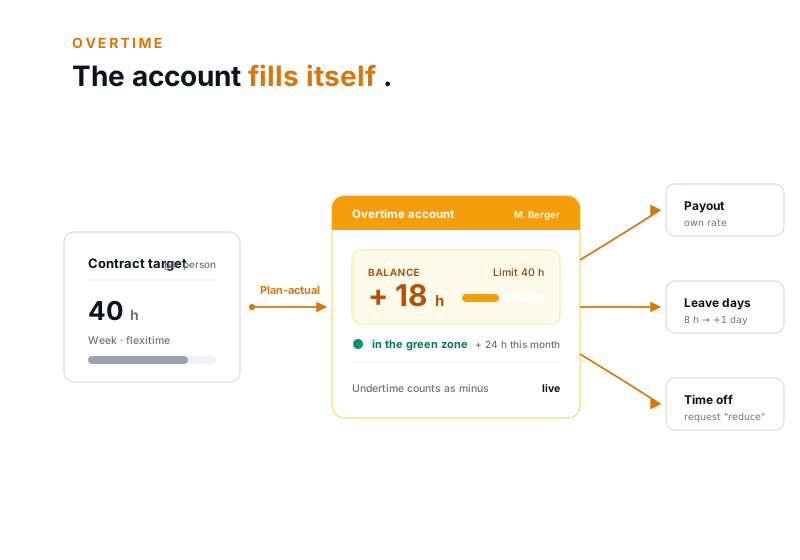
teamspace overtime: from the contract target and the recorded time comes an overtime account with a balance of plus 18 hours in the green zone, reduced by payout, leave days or time off

Overview

Record all working time, overtime included.

teamspace records the entire working time of your team, from check-in to the last booked hour. Everything beyond the agreed contract time is booked automatically as overtime by the system. No one maintains a second list for it, and you meet the recording duty of the Working Time Act at the same time.

Recording happens in the browser, in the installable web app or at the tablet, that is in the office, in the home office and on the road at the client. From the single office with under ten staff to the operation with several hundred employees, teamspace calculates against the stored contract target and keeps the overtime account running automatically.

The overtime problem

How much overtime does your team have right now?

  • Extra hours sit in heads and loose notes, a reliable balance is missing
  • At year-end or on leaving, staff and company argue over the number
  • No one sees early who is permanently overloaded, until the account tips over
  • Without an objective record, the employer carries the burden of proof in a dispute

That turns open hours into a financial and legal risk.

The term

What counts as overtime, and what does not.

Overtime is working time beyond the contractually agreed target time, ordered or tolerated by the employer. teamspace always calculates it against the contract target stored per person, not against a blanket benchmark.

Counts on the account:

  • every recorded hour above the daily or weekly target, depending on the rule from attendance or booked project time;
  • only time actually worked, accounted breaks stay out of it.

Overtime-neutral, that is neither plus nor minus:

  • leave and sickness, they fill the day up to the target;
  • public holidays and half working days per the stored working-time model.

Mechanics

How the overtime balance comes about.

An overtime hour is not a separate clock entry, it is a difference. Every day teamspace compares the stored target working time against the time actually recorded and books whatever is left over onto the account.

  • Contract target per person, depending on the model: 40 hours full-time, 30 hours part-time, flexitime with its own daily distribution.
  • Recorded time from check-in and check-out or from the project entries, less the accounted breaks.
  • Balance straight away: extra hours build up, short time counts as a minus, both in the same account.
  • Weighting optional: certain time pays onto the account with a factor. Travel time can count less, another activity more, set via the booked categories or areas.

Leave and sickness fill the day up to the target and stay overtime-neutral, so days off do not distort the balance.

Calculation rule

You decide what counts as an overtime hour.

For each employee you set the basis for the calculation. Three rules are available, configured in the contract data.

M. Berger

Contract target 40 h · configurable per person

rule selectable
Attendance time Rule 1

From the clocked time

Comparison clock ↔ daily target
Extra hour + 0.8 h
Basis check-in / -out
Project time Rule 2

From the project entries

Comparison entries ↔ daily target
Extra hour + 1.2 h
Basis logged project time
Trust-based work Rule 3

No calculation

Comparison not applicable
Extra hour not tracked
Basis no balance

One setting per person decides what counts, not a spreadsheet on the side.

The flow

From extra hours worked to a booked balance.

  1. 1

    Store the target working time

    Per person or contract model the target working time is fixed, with flexitime, half working days and fixed working days.

  2. 2

    Record time

    Staff clock in via browser, in the installable web app or at the tablet as a clock-in terminal. Start, end and breaks carry editor and timestamp.

  3. 3

    The comparison runs automatically

    teamspace compares target and actual. Extra hours land on the account, short time pulls it into the minus, both up to date.

  4. 4

    Check the threshold

    When the account reaches the set limit per month or year, the traffic light switches; at the absolute limit the recording of further overtime stops.

  5. 5

    Reduce or pay out

    Staff submit the request, managers approve. The hours go into the leave account or, via the employee billing, into the payroll export.

What overtime tracking takes over

Three things run automatically once the times are recorded. You set the rules, the account runs itself.

Plan-actual comparison, every day

  • teamspace compares the contract target with the recorded time daily.
  • Extra hours land on the account, short time pulls it into the minus.
  • No gathering from spreadsheets at month-end.

Account live, with a cap

  • The balance is there at any time, not only after billing.
  • Thresholds per month or year limit the build-up.
  • A traffic light shows who is nearing the limit.

Pay out or take as time off

  • Payout with your own rates or conversion into leave days.
  • Time off in lieu by request, in the same system.
  • No mail ping-pong, no second Excel list.

Thresholds

The traffic light shows who is accumulating too much.

Overtime only becomes a problem when it grows unnoticed. teamspace caps the account and makes the state of the whole team visible at a glance.

  • Threshold per month or year: above the limit, hours expire or are proposed for payout, depending on the setting.
  • Absolute maximum: once reached, the system records no further overtime; no one secretly keeps accumulating.
  • Traffic light per person: green, amber, red depending on the balance. You see who is fully loaded and who can still take on tasks. When which colour appears, you set yourself.

So the duty to record becomes a steering instrument for utilisation, instead of a list no one reads.

“We mostly work with the budget column.”

A consultancy steers its utilisation via the budget and hours view. Whoever keeps utilisation in view also sees where overtime piles up before the account tips over.
brandwerk consulting group

“Time tracking is far simpler and more convenient than in Excel.”

What used to run in Excel now runs in the system. From the same recorded times the overtime account forms, without adding up spreadsheets at month-end.
kwsoft

First call

Can your thresholds and rules be modelled cleanly?

In 20 minutes we walk through your contract models, capping limits and reduction rules. At the end you know whether teamspace carries your overtime practice.

Reduction

Three ways to reduce overtime again.

What happens with overtime is governed by collective agreement, contract and arrangement. teamspace maps the three common ways, each runs as a request in the same system.

  • Request "reduce overtime": the days off look like leave, but the leave account stays untouched. The overtime account only drops when the days are taken.
  • Conversion into leave days: a fixed number of hours is deducted from the account at once and credited as additional leave days, visible and traceable straight away.
  • Payout: staff request it, the review process runs like other payouts. Your own payout rates are stored in the settings.

Managers approve, the requester is notified, days off appear in the team calendar. Payouts run via the employee billing into the payroll export.

Self view

Everyone sees their own balance.

Fairness comes from transparency. Instead of waiting for an HR query, staff see their state at any time in their own overview.

  • Current balance in hours, with the stored limit alongside.
  • Difference in the period: how many hours were added or reduced in the chosen month.
  • Open requests for payout or time off, with their status.

HR and leadership see the aggregate view: overtime as a metric per team, alongside sick rate, home-office share and utilisation at the push of a button.
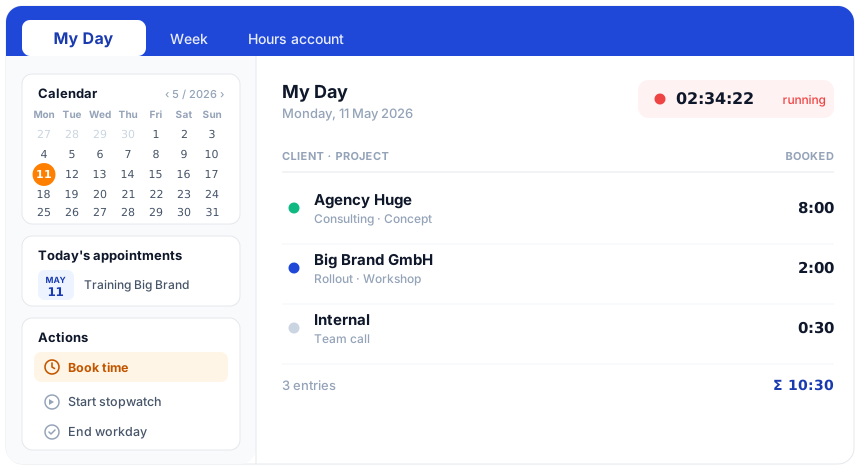
teamspace time tracking, My Day view: calendar, today's appointments and actions next to the day's time entries with a running stopwatch and day total

Part of time tracking online

Overtime is a use case of time tracking.

Timesheet, activity record, project hours and travel expenses run in the same system as the overtime account. One record feeds the plan-actual comparison, the hours account and the payroll data at once. How the whole module connects is shown on the overview page.

To time tracking online

Functions around overtime tracking

Recording and calculation

  • Plan-actual comparison per day and employee
  • Three calculation rules: attendance, project time, trust-based work
  • Contract models full-time, part-time, flexitime
  • Half working days and half public holidays
  • Breaks are accounted for automatically
  • Optional factor per category or area, for example travel time counts less

Account and thresholds

  • Overtime account in real time, with a minus balance
  • Threshold per month or year
  • Absolute maximum stops recording
  • Day limit blocks recording above a value
  • Traffic light per person, colours set yourself

Reduction and handover

  • Request 'reduce overtime' with approval
  • Conversion into leave days
  • Payout with your own rates via the employee billing
  • Surcharges as a percentage per time block (night, weekend, holiday)
  • Export for payroll preparation

Legal position

Why recording is mandatory today.

Since the German Federal Labour Court ruling of 13 September 2022 (case 1 ABR 22/21), which takes up the ECJ ruling C-55/18, it is settled: employers must systematically record the entire working time of their staff, overtime included. Whoever fails to do so falls into two traps.

Independent of this case law, the Working Time Act (ArbZG) already requires the record: under Section 16 (2) ArbZG, working time exceeding eight hours on a working day, that is the extra work, must be recorded and kept for at least two years. Whoever breaches this risks a fine of up to 30,000 euros under Section 22 ArbZG.

In a dispute over overtime pay, the employer carries the burden of proof if there is no objective record; the Federal Labour Court ruling 5 AZR 359/21 of 4 May 2022 tends to allocate it to their disadvantage. On top of that, supervisory authorities and works councils have a right to information and inspection, and a patchy record leads to objections.

teamspace supports a working-time record in the spirit of this case law: start, end, breaks and every correction are documented with editor and timestamp, approved periods can be locked against later additions. In a dispute the data state is traceably provable, not laboriously gathered from spreadsheets.

More use cases

What else time tracking carries.

The overtime account is one account of several. Six use cases run in the same system, on the same recorded hour.

Book project hours

Hours on project, phase and task, distinguished as billable or internal.

Learn more

Digital timesheet

Replace the Excel template with a cloud application with an activatable GoBD mode.

Learn more

Activity record

Hours record per client as a PDF at the push of a button.

Learn more

Travel expenses

Per-diems automatically by duration and country, receipts included.

Learn more

Manage leave and sickness

Request and approve absences and settle them in the time account.

Learn more

Record time via check-in

Clock coming and going at the terminal, in the app or in the browser.

Learn more

Frequently asked questions about tracking overtime

Are employers obliged to record overtime?
Yes. From the German Federal Labour Court ruling of 13 September 2022 (1 ABR 22/21) and the underlying ECJ ruling C-55/18 follows the duty to record the entire working time objectively and reliably, including overtime. Section 16 (2) of the Working Time Act already requires recording working time exceeding eight hours on a working day and keeping it for two years; a breach can be fined up to 30,000 euros under Section 22 ArbZG. Whoever does not record extra hours also risks back payments, because the Federal Labour Court ruling of 4 May 2022 (5 AZR 359/21) tends to allocate the burden of proof to the employer's disadvantage when there is no systematic record.
What is overtime anyway?
Overtime is working time that exceeds the contractually or collectively agreed target working time and is ordered or tolerated by the employer. The term extra work is often used synonymously; there is no binding statutory definition. Legally one distinguishes more finely: extra work means hours above the legally or collectively permitted maximum working time, overtime means hours above the individually agreed target time. teamspace always calculates against the stored contract target.
How much overtime is allowed?
The Working Time Act allows a maximum of ten hours per working day. Since Saturday counts as a working day, up to 60 hours per week are arithmetically possible. But the extra work must be balanced out: averaged over six months, the daily working time may not exceed eight hours on average. In teamspace, a day limit and thresholds per month and year can be stored so that these limits stay visible.
On what basis does teamspace calculate overtime?
This is set per employee in the contract data. Three rules are available: by attendance time (the clocked time is compared with the daily target), by project time (the booked project times are compared with the daily target) or not at all, under trust-based work. In the last case overtime is neither calculated nor shown.
Can overtime be paid out or taken as time off?
Yes, both, plus conversion into leave days. Staff submit the request in the system, managers approve. With the request 'reduce overtime' the account only drops when the days off are taken; with conversion into leave days at once. Payouts run with your own rates via the employee billing into the payroll export. Which way applies is configurable per collective agreement and company agreement.
Must a surcharge for overtime be paid?
The Working Time Act provides no entitlement to overtime surcharges. As a rule, only part-time staff or employees for whom surcharges are governed by collective agreement have an entitlement. In teamspace, surcharges can be stored as a percentage per attendance category and time block, for example for night, weekend or holiday work, so that the evaluated balance flows directly into the payroll export.
How is overtime tracking secured against later changes?
Every entry carries a timestamp, corrections are documented with editor and reason. Approved periods can be locked against later additions after the weekly or monthly write-once locking; after that only finance administration enters a closed period. With that the data state is traceably provable in a dispute.
Can staff view their overtime balance themselves?
Yes. In their own overview, staff see their current balance, the difference in the chosen period and their open payout or time-off requests. This transparency creates fairness and relieves HR, because no one has to ask about their own state.
Does every hour pay onto the overtime account equally?
By default yes, every recorded hour counts one to one. Optionally, certain time can be weighted with a factor, set via the booked categories or areas. So, for example, travel time can pay less onto the account and another activity more. For anyone who stores no weighting, it stays with the simple plan-actual comparison.
Where is the overtime tracking data stored?
In Germany, exclusively within the EU. 5 POINT AG, based in Darmstadt, has developed teamspace since 1999 and operates it in an ISO 27001 certified data centre in Frankfurt am Main. Your time and overtime data is processed GDPR-compliant, made in Germany.

Overtime tracking reviewed in 15 minutes.

In 15 to 30 minutes we talk through your contract models, your thresholds and the handover to payroll. You get an honest first opinion on whether teamspace fits your overtime practice.