
Spot the bottleneck early
- Overload is flagged before the project gets stuck.
- The warning system reports deviations in three tiers.
- Time to redistribute instead of escalate.
Staffing per person, team and project sits in one view. Leave, sickness and contracted hours are already factored in, so you see the real free capacity, and bottlenecks surface while there is still room to steer.
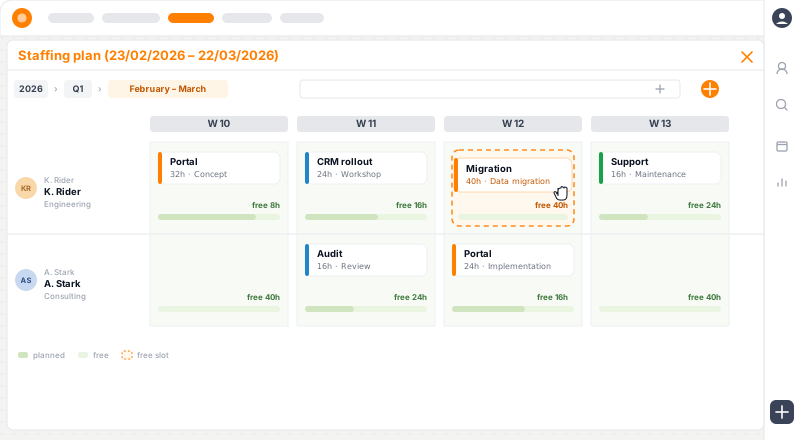
Overview
Everyday work
Capacity planning draws these answers from the data already sitting in teamspace.
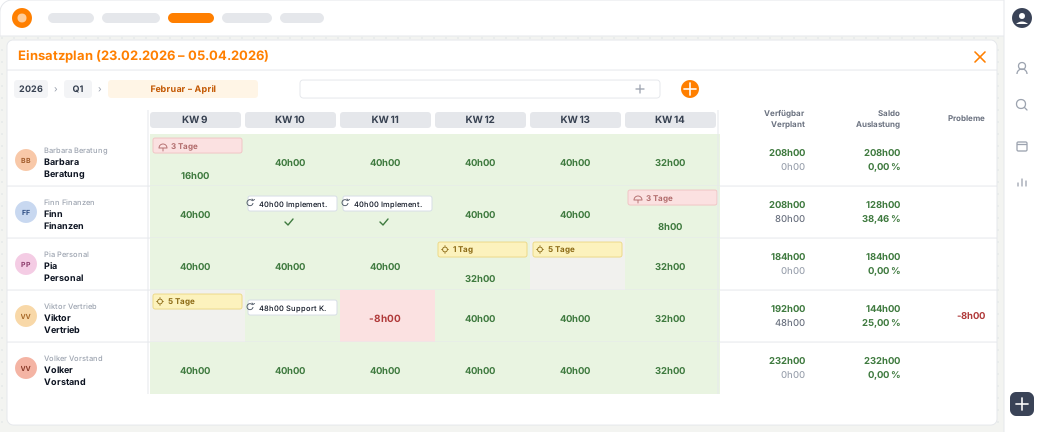
Utilisation per week
One axis shows the people, the other the calendar weeks. Each cell is the planned utilisation, leave stays clear, and an overload is flagged at once.
The model
Capacity planning rests on two building blocks. The capacity is its own unit, tied to one project or shared by many. The allocation is a person's concrete plan on it, rough by the month and precise by the day, both in parallel.
Project link
On one project
1:1, fixed to the project
Shared by many
a support or sales pool
Portal relaunch
Allocation
parallelMonth · rough
Jul
120 h
Aug
80 h
Sep
120 h
Day · precise
Mon
·
Tue
8 h
Wed
·
Thu
·
Fri
·
One capacity, and on it a person's plan, rough by the month and precise by the day, optionally for the team first, then for the person.
By the day
Why it matters
Allocation assistant
Availability
Allocating
You decide which logic the staffing follows.
Plan by your functional areas, say consulting, engineering or support.
Where a team looks after fixed clients, assign the staff to match.
Technical, language and interpersonal skills are held per person on a scale from 0 to 9. You filter by the required skill and make the assignment yourself.
Case Study
Who is in? Who is on which project? How much capacity is still free? con|energy consult answers questions like these straight out of day-to-day work, with capacity planning.
„We plan which project each member of staff works on every day."

Usage types
At a glance
Capacity planning is not a rigid grid; it adapts to your organisation.
spread modes: early, late, even
views: project, person, organisation
warning tiers: notice, warning, critical
analysis freely selectable
Analysis
Intro call
In around 20 minutes we work through your team structure, the skills on file and your utilisation. You get an honest first read on whether teamspace fits your planning.
Use cases
Capacity planning is one building block. These use cases draw on the same project and staffing data.
Steer several projects in parallel and surface resource conflicts.
Learn morePlan vs actual, margin and forecast per project.
Learn morePhases, work packages and owners per project.
Learn moreSchedule and cost variance, plus the projected remaining work.
Learn moreLogged hours become the invoice with the right rates.
Learn moreLog hours on project, phase and work package.
Learn moreLooking ahead
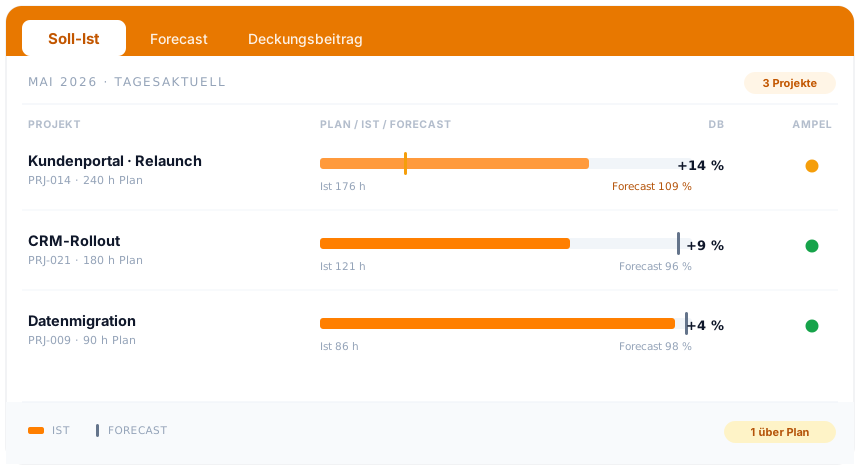
Part of project management
Orders become projects, work packages become staffing, logged hours become plan vs actual. The project management overview shows how the pieces fit together.
More on project managementCapacity planning for service firms
Related modules
Running projects almost always means dealing with the hour, the invoice and the order. Here are the shortest routes there.
Logged hours are the basis for utilisation, plan vs actual and billing.
Completed project work becomes the invoice with the right rates.
The accepted quote becomes the project; order and customer file stay linked.
We look together at your team structure, your skills and your utilisation, and tell you honestly whether teamspace fits your planning.