
Plan and actual on one structure
- Planned and logged hours hang on the same node.
- No reconciliation between a plan sheet and a time tool.
- Plan vs actual stands at every level.
With teamspace work breakdown structure software you break projects into phases and work packages. Every node carries plan hours, a budget and an owner, and hours are logged straight onto it. Part of the cloud software for project management, with no per-module surcharge.
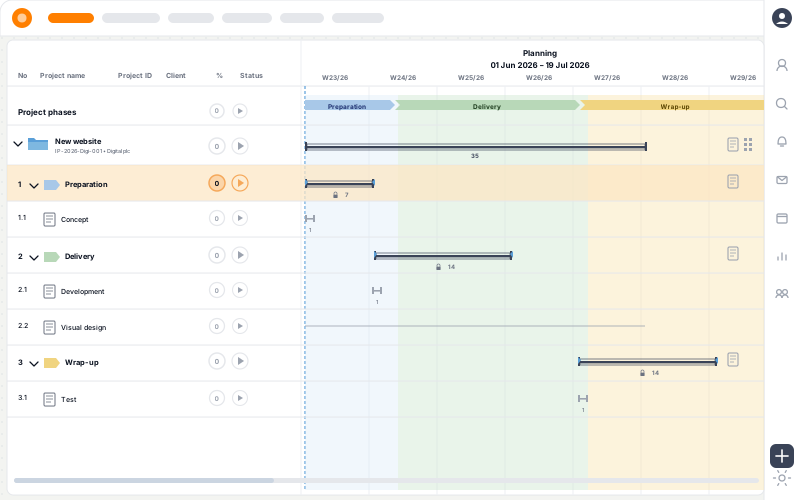
Feature set
A structure becomes a tool only once plan and reality hang on the same structure. Three things decide whether it does.
The core
A work breakdown structure breaks a project down hierarchically into subprojects and work packages. It orders the venture independently of dates and is the basis from which schedule, cost and resource planning are derived. In practice it is often called the "plan of plans".
The structure itself rests on three elements: main project, subproject and work package. You nest subprojects as deep as you like; the work package is the lowest unit, with hours, owners and a budget.
Phases and milestones come in as their own levels. A phase lays itself over the project in time (preparation, planning, build) and can serve as a filter or on the project's summary card. A milestone marks a fixed date, project-specific or global across all projects, independent of the structure. You use only as many building blocks as the case at hand calls for.
Unlike a pure drawing tool, the structure in teamspace stays the place where the work happens: hours are logged straight onto the node, rather than landing in a second spreadsheet.
From order to project
Anyone planning client projects rarely starts from a blank plan. A confirmed order becomes a project in one click, and the line items become the structure.
Schedule and cost frame come along from the order, and you only need to enter the owners.
Plan data
Every phase and every work package carries its own plan data: plan hours, a budget in euros, an owner and a period. You set the start as a fixed date, as a milestone or in reference to a predecessor.
Which rates are billed in the end is decided in project billing, not in the structure itself.
“Time tracking is far simpler and more convenient than in Excel.”

Logging
The real lever is logging straight onto the node. In their time tracking, staff see the work packages they are assigned to and log without a detour through a separate project list.
The hours come from three sources, and all land on the same package:
An hour on "backend" rolls up automatically to the "build" phase and the project. So plan vs actual stands at every level, current to the day, without anyone synchronising tabs at the weekend. Go deeper into project controlling.
In figures
What makes the difference between a drawn plan and a structure that carries the whole project.
freely combined
Main project, subproject, work package, phase, milestone
no level limit
Nest subprojects until the structure fits
on one structure
Hours are logged straight onto the node
hosting in Frankfurt
ISO 27001 certified data centre
In the run
A structure is built entirely in the browser, with no local tool. Five steps to the first logged hour.
Copy from an earlier project or start empty. Templates already bring typical phases, milestones and resources along.
Subprojects as deep as you like, work packages per phase. Each node gets plan hours, a budget and an owner.
Per work package, tasks are created, or a ticket from the service desk is assigned.
Staff log straight onto the node. Progress rolls up automatically to phase and project.
Shift phases, re-cut work packages, swap owners. The project history records every change.
Dates
Milestones mark a project's fixed dates. teamspace keeps project-specific and global milestones; global ones apply across all projects and show the state of several ventures at a glance.
The milestone trend analysis re-sets the date in every project report. The course over time forms a trend line: if a milestone moves back from report to report, the slippage is visible long before the date itself breaks. A pre-warning date can be stored per milestone.
Across many ventures you keep the overview in multi-project management.
Files
You use the work breakdown structure not only for planning but, if you wish, as a file store. The directory follows the structure: where the work package sits, the file for it sits too.
So the structure becomes a tool for project documentation at the same time.
Your questions
In 20 minutes we go through your typical projects and the right depth of structure. After that you see how a structure in teamspace looks for your case.
From practice
At runtime
Projects change. Phases get re-cut, work packages merged, owners swapped. teamspace allows these changes in a running project.
You shift a whole project by a number of days in one click; a checkbox decides whether subprojects, resources and milestones move along. The project history records status and schedule changes automatically, with the editor and the time.
So it stays traceable who changed what and when, without anyone keeping a log by hand.
More from project management
The structure is one of several views on the same project. These areas go deeper into individual questions.
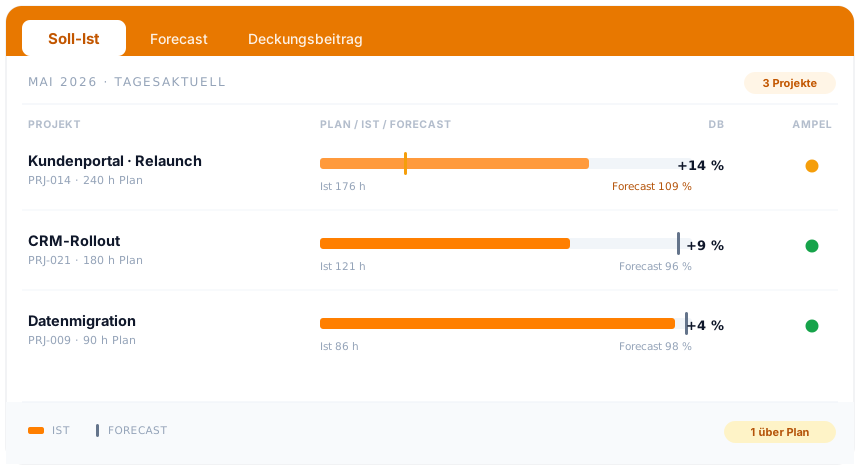
Plan vs actual, forecast and margin per node of the structure.
Learn moreUtilisation per person and team from the plan data.
Learn moreMany projects in parallel, each with its own structure.
Learn moreEarned value and forecast from plan and actual cost.
Learn moreThe logged hours of the structure become the invoice.
Learn moreWiki and files hang on the phase and work package.
Learn moreIn detail
In overview
The structure carries plan and actual. How teamspace plans, steers and bills projects from it, from plan vs actual through utilisation to the invoice out of the project, the project management overview shows.
To project managementBackground
The first question with any structure is not the software but the cut: by what do we break the project down? Three forms are common, and teamspace prescribes none of them.
By function, by object or by time. A function-oriented breakdown cuts by trade or discipline, such as copy, design and programming. An object-oriented one puts the result at the centre and splits it into its parts, such as hardware, software and documentation. A time-oriented one follows the run, from analysis through build to sign-off. One form carries per planning level; across the levels, mixed forms are normal.
Top-down or bottom-up. Whoever knows the whole plans from the top down to the single work package. Whoever starts from concrete packages builds from the bottom up to the overall project. The yo-yo method switches deliberately between the two directions. Which way fits depends on the project, not on the tool.
Why not Excel. As a spreadsheet a structure can be drawn, but plan and actual then live in two worlds: the structure in the sheet, the hours in an app, the invoice somewhere else. teamspace reads an existing structure in via Excel and exports it again too. The difference: logged hours, budget and progress hang on the same structure, multi-user and with a gapless history.
Related modules
Anyone structuring a project almost always deals with the hour, the invoice and the customer. Here are the shortest routes there.
Staff log hours straight onto the work package of the structure.
The hours and budgets of the structure become the invoice, with rates and flat rates.
The order the project comes from sits in the customer file on the contact.
Intro call
You show us a typical project, we show you the structure behind it, with phases, work packages and logging straight onto the node. After that you decide whether this is the right way for your projects.