
Silo solutions or all-in-one software?
Digitalisation has produced countless software solutions for business processes. From specialised tools for single areas to all-in-one systems that cover many functions at once, the choice is yours. Both have pros and cons, but experience shows: a well-designed integrated solution offers more efficiency and stability in the long run.
Digitalisation has produced countless software solutions for business processes. From specialised tools for individual areas to all-in-one systems that cover many business functions at once, you face a choice: bet on specialised silo solutions or on an all-in-one software? Both approaches have pros and cons — but from years of experience as a software provider, a thoughtful integrated solution offers more efficiency and stability in the long term.
What are silo solutions?
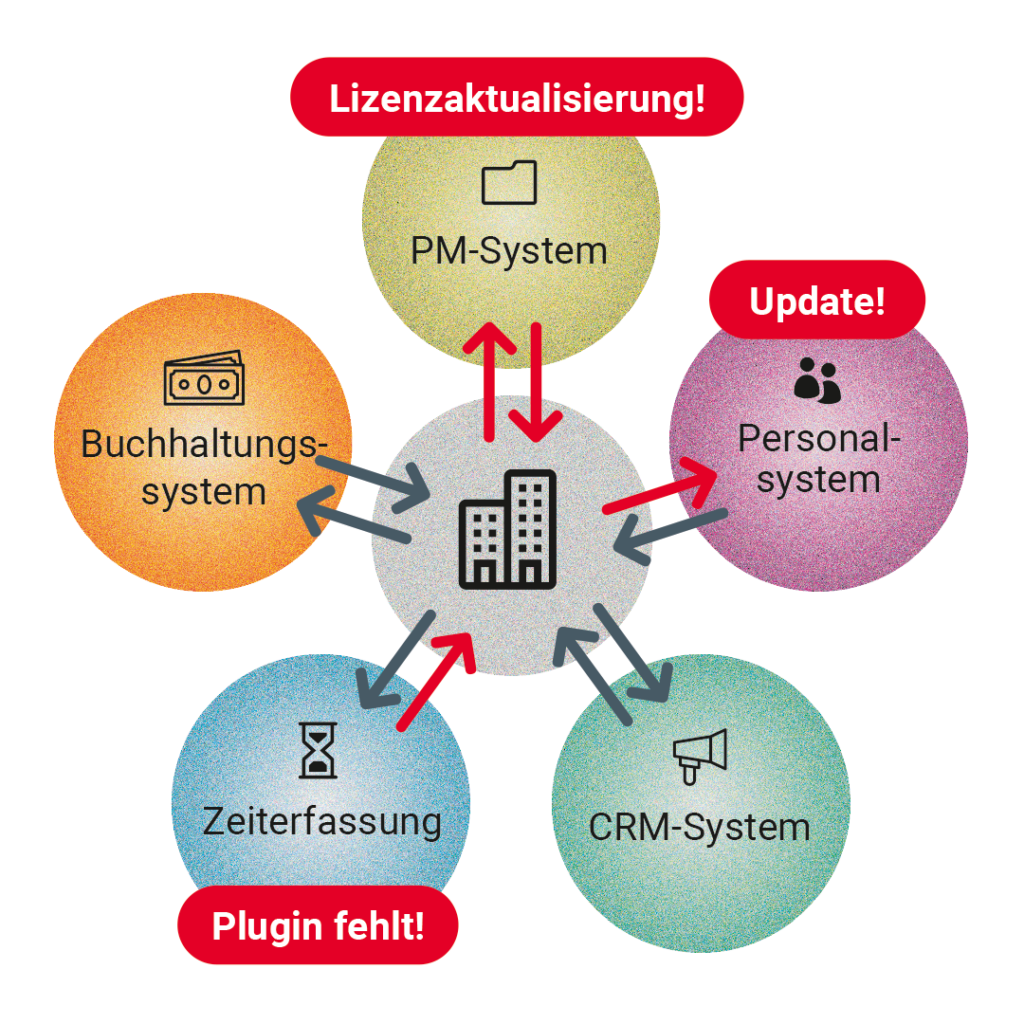
When a company uses several different software tools for different tasks, silo solutions emerge. Each tool meets its specific requirements well, but the overall setup brings challenges:
- Multiple credentials and storage locations: employees have to log in to several platforms, which is cumbersome.
- Difficult data exchange: information is spread across systems, causing inconsistencies or delays.
- Complicated onboarding: new hires have to learn many systems, slowing them down.
- Higher cost: each tool has its own licence fee. The sum quickly exceeds the cost of an integrated suite, even when not every feature is used.
- Data security and compliance: GDPR and similar rules are harder to enforce when data is spread across many systems. Data is also easier to lose.
Integration as a fix?
Many companies try to connect silo solutions through interfaces. That can work in single cases, but typically brings high implementation cost. Technical constraints often prevent seamless sync. Updates or platform evolution can break the integration over time.
Advantages of all-in-one software
A centralised solution removes many of these problems:
- Efficient data management: all relevant information sits in one place, easy to access for authorised users.
- Lower error rate: consistent data means fewer misunderstandings and less duplicate work.
- Streamlined onboarding: new hires need less training and get an overview of processes and structures faster.
- Cost savings: even though all-in-one licence fees may look higher, they often beat the sum of separate point solutions.
- Scalability: integrated solutions grow with your business and adapt to your needs.
- Better compliance and security: a unified architecture makes privacy rules easier to enforce and reduces security risk.
Is a hybrid setup sensible?
In some cases a mix of an all-in-one core and specialised tools makes sense. Then it matters that the systems integrate seamlessly and that admin overhead does not get out of hand. A well-designed API can help, but central data management remains a challenge.
Practical examples
Many companies report inefficient processes when they work with several silo solutions. For example, teams struggle to find current documents or tasks because they sit in different systems. The result: misunderstandings, delays, more communication overhead.
A real-world example: a mid-sized company used one tool for project management, another for time tracking, yet another for invoicing. Accounting had to transfer information between systems manually, leading to errors and significant lost time. After moving to an all-in-one solution, processes were streamlined, time was saved and errors went down.
What to look for
When choosing software, focus on:
- Functional coverage: does the software cover the most important business areas, or do you need to integrate additional tools?
- Usability: is it intuitive, or does it require extensive training?
- Scalability: can it grow with your business?
- Support and product evolution: are there regular updates and competent support?
- Data security: does the software meet all required privacy standards?
Our conclusion
Which solution is right depends on your specific needs. But in practice the picture is clear: an all-in-one software offers more benefits in the long run and secures a stable business architecture. It reduces error sources, saves cost, and makes process management easier.
Our recommendation: go for a thoughtful integrated solution like teamspace. Contact us and learn how we can support your business.
Read on
Reviewed in a requirements check
You have questions on this topic? In a 15- to 30-minute meeting we discuss your specific requirements, free of charge and without obligation.
Software that fits your setup?
In a 15-minute meeting we look at your requirements together and give an honest first opinion.