teamspace

Software for management consultancies that steers utilisation and bills engagements cleanly.

teamspace makes utilisation visible across teams, practices and seniority levels and brings fee rates, consulting days and travel expenses together in one fee invoice. So you plan your consultants reliably and bill every engagement cleanly.

Calm, light teamspace-style scene: an open weekly planner shows a consultant's days for the week, several booked on engagements and one left free. Beside it a travel bag and a notepad, and a small teamspace card top right showing the week's utilisation at 78 percent.

Success factors

What sets successful consultancies apart

Successful consultancies combine subject-matter excellence with clear structures in day-to-day project work: they steer their engagements confidently, keep effort and profitability in view and create transparency, internally and towards their clients.

Steer consulting engagements confidently

Keep an overview of project progress, budgets and deliverables at any time. Engagements are steered actively, not just assessed after the fact.

Effort and profitability in view

Sound decisions are built on reliable figures. Transparency over hours, fees and project profitability is the precondition for profitable engagements.

Collaborate efficiently as a team

When project information, tasks and effort are clearly structured, internal coordination drops. Teams focus on the actual consulting work.

Appear professional towards clients

Clear project status, traceable effort and transparent invoices strengthen trust and professionalism in the relationship with clients.

A shared foundation

These success factors need a shared data foundation.

Confident steering, transparency and clean invoicing only work when projects, effort and fees come together. Single tools and manual evaluations hit their limits here. And in the consulting business, utilisation drives revenue: a billable day that stays empty earns no revenue and never comes back.

Beraterwoche · KW 21
auf Mandat leer
MoDiMiDoFr
Partner 2.400 €
MüllerMüllerleerSchmidtleer
Senior 1.600 €
WeberWeberWeberWeberleer
Manager 1.200 €
MüllerleerSchmidtSchmidtSchmidt
Consultant 900 €
WeberWeberleerleerBecker

Auslastung

70 %

verkauft 14 Tage
leer 6 Tage

14 von 20 Tagen verkauft. Die 6 leeren kommen nicht zurück.

Day to day

What management consultancies gain with teamspace

One system for what really counts in consulting: project steering, transparency and sound decisions. Three things growing consultancies notice first.

Utilisation before the week begins

Who is free next week, who is already full? teamspace shows it across teams, practices, locations and levels, with leave and absence already factored in.

Margin per engagement, day by day

Internal rates against fees, per engagement and phase. Partners see whether an engagement is on track, not only at quarter-end.

Less admin at month-end

Hours, travel expenses and fees flow into the invoice with no Excel detour. Quarter-end no longer ties up days.

Staffing

See double-booking before the engagement starts.

The costliest conflict surfaces on day one of the engagement: two engagements, one Senior, both need them fully. In teamspace the staffing assistant flags it beforehand, across all engagements.

  • Plan by department, client or field of expertise: the system filters by available skill and reports conflicts. The person who plans makes the choice.
  • Leave and absence are already deducted before anyone is scheduled.
  • First the team roughly, then the person precisely: broken down from month to day, in a single view.

Utilisation can be switched by project, employee or organisation, by day, week or month. Capacity planning is part of the enterprise edition.

To capacity planning

CRM for management consulting

A CRM for management consultancies must do more than keep contacts.

Generic CRM plus Excel utilisation plus invoicing tool

  • Utilisation lives in a spreadsheet no one keeps current
  • Fee rates per level are entered by hand into every invoice
  • The client structure does not fit a generic CRM
  • Margin per engagement is only known after quarter-end
Recommended

teamspace

  • Utilisation across teams, practices and levels in one view
  • Fee rates by level and engagement that pull automatically
  • Group, client and engagement as a connected structure
  • Margin per engagement day by day, internal rates against fees

Scope

Software that bills by level and grows with you.

Three properties that make the difference in the day-to-day of a growing consultancy.

Utilisation and fees from one source

The booked consulting days are at once the utilisation and the basis of the fee invoice. One data foundation, no transfer between spreadsheets.

Bills by level, not flat

Partner, Senior, Manager and Consultant each carry their own day rate that pulls automatically by level and engagement, with a validity period.

Grows from office to firm

From CRM and time to full utilisation steering: light, office and enterprise are configuration, not data migration.

Fee rates

Rates per level and engagement, pulled automatically.

Partner, Senior, Manager, Consultant: each level has its rate, the key client perhaps its own. In teamspace these rates live in the master data and pull into the invoice automatically.

  • Rate per employee and engagement, with a validity period, instead of a price list someone has to keep current.
  • No typo, no outdated spreadsheet: the fee invoice reads the stored rate.
  • Surcharges run along, for instance for evening or weekend work.

So the invoice is created from the recorded days, not from a fee list kept in parallel.

To invoicing software

“I save a lot of time writing invoices.”

con|energy consult runs engagements, hours and fee invoicing in one system. Instead of silo solutions with double upkeep, everything sits on one data foundation.
con|energy consult

What consultancies gain

Utilisation, fees and group view under control.

Three strengths growing consultancies value most: making the days plannable, getting the fee invoice clean and seeing the group as a whole structure.

Utilisation

The days plannable before they lapse.

Utilisation across teams, practices and levels, with conflict alerts before the engagement starts and leave already factored in.

  • Utilisation across teams, practices and locations
  • Conflict alert before the engagement starts
  • Leave and absence accounted for automatically

Fees

One invoice for days, flat rate and travel.

Consulting days on time and materials, a workshop flat rate and travel expenses mix in one document, with an activity record.

  • Time and materials, flat rate and fixed price in one invoice
  • Activity record automatically per invoice
  • ZUGFeRD and XRechnung without an add-on tool

Group

Holding, subsidiary and engagement in one structure.

More than a generic CRM can do: consolidated reporting across subsidiaries, separate invoicing and permission views per level.

  • Group, client and engagement as connected levels
  • Consulting days consolidated across all subsidiaries
  • Separate permissions per level

The path of an engagement

From first contact to the fee invoice.

An end-to-end path on one data foundation, with no export between CRM, utilisation spreadsheet and invoicing tool: the inquiry becomes the engagement, the days become the invoice.

  1. 1

    Inquiry and acquisition

    Inquiries and quote preparation sit in the CRM, with client history, key contacts and acquisition time on the record.

  2. 2

    Quote with fee structure

    Consulting days per level, workshop flat rates, travel expenses and options, the rates pulled from master data instead of typed by hand.

  3. 3

    Open and staff the engagement

    Once awarded, the engagement is created with phases, budget and team. The staffing assistant shows free capacity and reports conflicts.

  4. 4

    Record consulting days and travel expenses

    Consultants book days in the browser or web app, at the client or on the train. Travel expenses are added by receipt, flat rates calculate themselves.

  5. 5

    Fee invoice and record

    The invoice is created from recorded days, flat rates and travel expenses. The activity record attaches automatically and goes to the client for signature.

What matters

Booked, billed, evaluated, in one system.

Highlight 1

Book where the work happens.

Consultants book the day in the browser or web app, at the client or on the train. Each day carries its category, billable or internal.

Highlight 2

One engagement invoice, many models.

Effort, workshop flat rate and travel expenses mix in one document, the activity record attaches automatically.

Highlight 3

One data foundation, no export.

Utilisation, fees and the client record draw on the same base, with no CSV between utilisation spreadsheet, time tool and accounting.

Seen in the system

The staffing plan, week by week, person by person.

Every person, every week, with scheduled days, leave and a flagged overbooking. Alongside it: available, scheduled and free capacity, so a double-booking shows before the engagement begins.
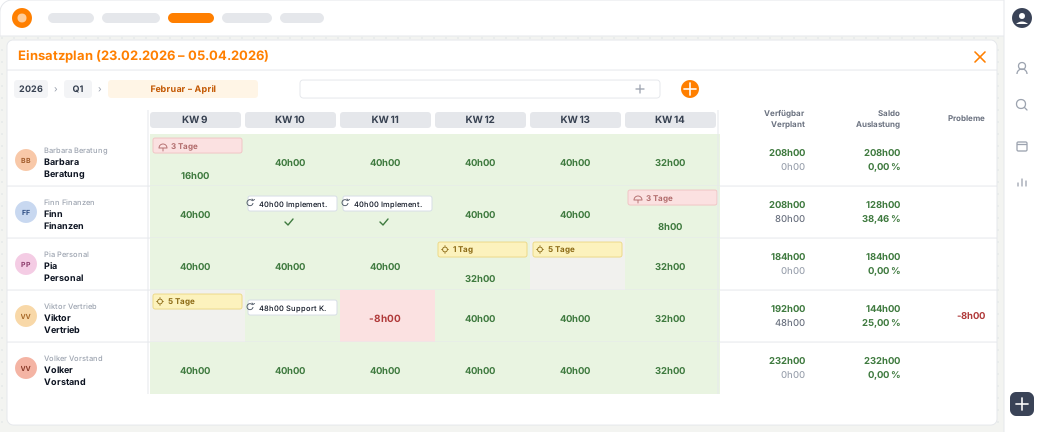
teamspace staffing plan W9 to W14: five people with capacity tiles per week, leave bars, booking strips and an over-booking of minus eight hours for Viktor Vertrieb in W11, with the columns Available, Allocated, Balance, Utilisation and Issues on the right.

Intro call

See it on your own utilisation.

In the intro call you see, on your own staffing situation, how teamspace makes utilisation visible and where your fee models are reflected.

Book a call

Organisational structure

Holding, subsidiary, engagement in one structure.

A holding awards the engagement, the subsidiary pays the invoice. A generic CRM knows only the one contact. teamspace maps the whole structure, in a hierarchy that runs as deep as your client is nested.

  • Hierarchy of any depth: group, subsidiary, division and engagement as connected levels, with no fixed number of tiers.
  • Evaluate separately and consolidated: each level with its own view, plus the roll-up across all subsidiaries, for instance consulting days per practice over twelve months.
  • The same principle for your own firm: you map locations and departments through the same hierarchy as the group structure of your clients.
  • Permissions per level, so partners, account owners and consultants see exactly what they are meant to.

This is the basis on which partners spot their follow-on business within the group.

To key account management

Who it fits

Which consultancies get the most out of this.

teamspace fits firms that live on utilisation and fees. Three profiles we see particularly often.

Strategy and management consultancies

  • Multi-week engagements with rates by seniority level
  • Workshop flat rates and time and materials in one invoice
  • Utilisation across several practices and locations

Mid-sized consulting firms

  • Several practices with consolidated reporting
  • Group, client and engagement structure
  • Fee rates with a validity period per engagement

Specialist consultancies

  • Lean engagement structure, fast quotes
  • Start with CRM, time and fee invoicing
  • Utilisation and travel expenses without Excel

Fee invoice

Consulting days, flat rate and travel expenses in one invoice.

A typical engagement invoice is rarely a single model. It mixes consulting days on time and materials, a fixed workshop flat rate and travel expenses as pass-through. teamspace brings that together in one document.

  • Time and materials, flat rate and fixed price side by side, cleanly separated between billable and non-billable.
  • Travel expenses as pass-through or with a markup, billed on to the client or booked as your own cost.
  • The activity record is created automatically from the booked days and attaches to the invoice.

The finished invoice goes out as ZUGFeRD or XRechnung, without anyone switching the format.

To travel expense management

Comparison

Four tools or one system.

Where an end-to-end system differs from a CRM with Excel utilisation and a separate invoicing program.

Feature

CRM, Excel, invoicing tool

teamspace

Recommended
Utilisation across teams, practices and levels
Conflict alert before the engagement starts
Fee rates by level and engagement, pulled automatically
manual
Group, client and engagement structure
limited
Time and materials, flat rate and travel expenses in one invoice
manual
Activity record automatically per invoice
Margin per engagement day by day
ZUGFeRD and XRechnung without an add-on tool
Hosting in an ISO 27001 data centre in Frankfurt
varies

Availability

Schedulable days, with leave already deducted.

How many days does a consultant really have free next week? The question decides every staffing call. teamspace works it out instead of guessing.

  • Contract time minus leave minus public holiday gives the schedulable time, automatically from the system.
  • Absences deduct themselves before anyone is put on an engagement.
  • The view can be switched between project, employee and organisation.

So no one plans against a spreadsheet nobody trusts any more.

To capacity planning

Scope

Features for consultancies at a glance.

Included in the plan, with no module surcharge. Utilisation planning is part of the enterprise edition.

Engagement and fees

  • Fee rates by level and engagement with a validity period
  • Time and materials, flat rate and fixed price in one invoice
  • Travel expenses with per diems, as pass-through or with a markup
  • Activity record automatically per invoice
  • Group, client and engagement structure

Utilisation and staffing

  • Utilisation across teams, practices, locations and levels
  • Staffing assistant with conflict alerts
  • Plan by department, client or field of expertise
  • Leave and absence accounted for automatically
  • Rough and fine planning from month to day

Billing and steering

  • Margin per engagement and phase, day by day
  • ZUGFeRD and XRechnung without an add-on tool
  • Handover to DATEV Unternehmen online
  • Timesheets with approval and lock
  • Client reporting on consulting days and effort

Intro call

We walk through your utilisation and fee models.

Show us your engagement structure and one fee model. We show how teamspace makes utilisation visible and how the invoice is created from it.

Why teamspace

Who builds and runs teamspace.

Since 1999 from Darmstadt

We have built teamspace in Darmstadt since 1999, self-funded and without outside capital. Consultancies from the small office to the mid-sized firm work with it every day.

Hosting in Frankfurt

Operated in an ISO 27001 certified data centre in Frankfurt am Main, data processing exclusively within the EU. The data centre is certified, not teamspace itself.

Confidentiality by engagement

Who sees which engagement is your call, via roles and rights. Sensitive client strategies stay restricted to the consultants working on them.

Case Study

From Excel chaos to day-by-day utilisation.

Hypothetical practice example to illustrate the effect. Concrete values depend on starting point, size and execution and are not guaranteed. A typical migration scenario: a growing strategy consultancy with three practices and around 30 consultants moving from Excel utilisation, a generic CRM and separate invoicing software onto teamspace.

Starting point

Hours sat in a time-tracking tool, utilisation in Excel, client data in the CRM, fees in Word templates, invoices in a third application. Quarter-end tied up a Senior and the office management for days. Which consultant was free when sat in a spreadsheet nobody trusted.

Solution

With teamspace, consultants book their days directly on the engagement. Utilisation and margin are visible day by day, conflicts surface before the engagement starts. The engagement invoice mixes time and materials, flat rate and travel expenses and is created from the recorded days, with an activity record.

1

system instead of CRM, Excel and invoicing tool

live

utilisation across teams and practices

0

Excel lists for utilisation

Module overview

Modules around engagement and utilisation.

Six areas go deeper into individual questions around engagement, fees and the days of your consultants.

Capacity planning

Utilisation across teams and levels, staffing assistant with conflict alerts.

Learn more

CRM software

Clients, groups and contacts in one place, with acquisition and history.

Learn more

Key account management

Group, client and engagement as a structure, consolidated across subsidiaries.

Learn more

Time tracking online

Consulting days in the browser or web app, at the client or on the train.

Learn more

Invoicing software

Fee invoice with time and materials, flat rate and travel expenses, ZUGFeRD and XRechnung.

Learn more

Travel expense management

Receipts via web app, per diems automatic, billed on to the client.

Learn more

What software for management consultancies must do

Engagement, utilisation and fees on one data foundation.

Software for management consultancies brings engagement, utilisation and fees onto one data foundation: consulting days and day rates by seniority, utilisation across teams and practices, a fee invoice that mixes time and materials, flat rate and travel expenses. That is what sets it apart from a generic CRM with an Excel sheet alongside.

In the consulting business, utilisation is the most important steering metric. Revenue comes from booked days times day rate, and a Senior's free day never returns. Suitable software makes this utilisation visible before the week begins and flags double-bookings before day one of the engagement.

Read that way, teamspace is an integrated system for project-based consultancies that runs CRM, utilisation, time tracking and fee invoicing in one logic, closer to the day-to-day of a firm whose product is its people's time.

Terms

Six terms from the consulting day-to-day.

Words that come up again and again in engagement, staffing and fees.

Consulting software
An application that runs the engagement, utilisation and fees of a management consultancy on one data foundation: consulting days and day rates, utilisation across teams and practices, a fee invoice for time and materials, flat rate and travel expenses.
Utilisation
The share of sold days out of possible consulting days. In the consulting business the most important steering metric, because revenue comes from booked days times day rate.
Consulting day
The billable unit of consulting. One day of a consultant on an engagement, valued at the day rate of their seniority level.
Seniority level
The experience level of a consultant, from Partner through Senior and Manager to Consultant. Each level has its own day rate.
Practice
A subject area of a consultancy, for instance strategy, restructuring or digital. teamspace evaluates utilisation and margin per practice.
Activity record
The breakdown of the days delivered for an invoice. In teamspace it is created automatically from the booked time and can be sent to the client for signature.

More industries

Solutions for other service firms.

teamspace comes for five industries. Here are the four besides management consulting.

IT service providers

Project and ongoing operations, every hour on the right contract.

Industry page

Systems house

Product and service on one invoice, hardware and licences as their own line items.

Industry page

Agencies

Fees plus external costs, the budget as one unit and a freelancer pool.

Industry page

Architects and engineers

Planning at the HOAI fee, work phases and variations.

Industry page

An honest fit

Which consultancies teamspace fits, and which it does not.

Fits less well

  • Pure to-do or task teams with no fee and utilisation logic.
  • Product, goods or trading business with stock and inventory.
  • Production and manufacturing with materials management.
  • A single seat without a team, where utilisation is not a steering metric.
Recommended

Fits well

  • Consultancies that sell consulting days and bill by time and materials, flat rate and workshop.
  • Firms with utilisation steering across teams, practices and seniority levels.
  • Engagements with fee rates by seniority, travel expenses and an automatic activity record.
  • Consultancies from the small team to several hundred employees, with several parallel engagements.

Frequently asked questions about teamspace consulting software

Which consultancies does teamspace fit?
teamspace is a cloud consulting software made in Germany, designed for firms from around five staff to several hundred consultants. Strategy, management and specialist consultancies (HR, restructuring, digital) use teamspace, as do small, lean consulting practices.
Can different day and hourly rates be modelled in teamspace?
Yes. teamspace manages fee rates per seniority level (Partner, Senior, Manager, Consultant), per client and per engagement. The rates have a validity period and apply automatically at invoicing, without spreadsheet upkeep or manual selection.
Is teamspace a CRM for management consultancies?
teamspace includes a CRM for management consultancies, but it goes further: clients, group structures and contacts sit in one place, connected to utilisation, time tracking and fee invoicing. A generic CRM manages contacts and pipeline; teamspace additionally runs consulting days, fee rates and engagement billing on the same data foundation.
How does the client structure work for group clients?
In teamspace clients can be mapped as a group structure: a holding with several subsidiaries, each subsidiary its own commissioner. Reports can be aggregated on group, client or engagement level, with separate permissions for partners, account owners and consultants.
Which fee models does teamspace support?
teamspace combines time and materials, fixed price and flat rates in one fee invoice, plus travel expenses as pass-through or with a markup. A single engagement invoice can contain several models at once, for instance a workshop flat rate plus time and materials for the follow-up plus travel expenses.
How well does utilisation and capacity planning work?
Capacity planning shows utilisation across teams, practices, locations and levels, with leave and absence already factored in. The staffing assistant filters by available field of expertise and reports conflicts across all engagements; the person who plans makes the choice. Capacity planning is part of the enterprise edition.
Is an activity record created automatically?
Yes. For every invoice that settles time, an activity record is created with the booked consulting days following the rules stored on the engagement. It is editable before sending and can be sent to the client online for signature.
Can we connect teamspace to our accounting?
teamspace ships a certified interface to DATEV Unternehmen online, through which invoices go straight into the DATEV cloud. Lexware and Sage have no direct interface; there the standard export handles the handover.
How do management and partners benefit from teamspace?
teamspace shows margin per engagement, utilisation across practices and the fees from open invoices at any time. Quarter-end, which costs days in an Excel landscape, rests on a shared data foundation instead of manual preparation.
Where is the consulting data stored?
teamspace runs in an ISO 27001 certified data centre in Frankfurt am Main, processing exclusively within the EU. The data centre is certified, not teamspace itself. The contracting party is 5 POINT AG, based in Darmstadt, under German law.
Is teamspace suitable for small consulting practices too?
Yes. teamspace is productive from one licence, recommended from five, and grows with you. Small practices usually start with CRM, time tracking and fee invoicing and add utilisation planning later. The edition change from light through office to enterprise is configuration, not data migration.
What does teamspace cost for a consultancy?
teamspace is billed per user and month, in three editions from 7 euros (light), 19 euros (office) and 24 euros (enterprise). Consultancies with utilisation planning use the enterprise edition. You pay only for active users; the exact terms are on the pricing overview.
Which software do management consultancies really need?
A management consultancy needs software that connects client management, utilisation planning, time tracking and fee invoicing on one data foundation. Single tools lead to double upkeep and show utilisation only once the week is over. teamspace brings these areas together in one system.

Intro call

Consulting software reviewed in 15 minutes.

In 15 to 30 minutes we discuss your engagement structure, fee models and utilisation. You hear a clear opinion on whether teamspace fits your consultancy.