teamspace

Software for small service businesses: projects, CRM, time and billing in one system.

Firms that deliver client projects with ten to a hundred employees often juggle a project tool, Excel, a time tracker and the accounts. teamspace brings project management, CRM, time tracking and billing together on one set of data, so that a logged hour turns into an invoice with no detour.
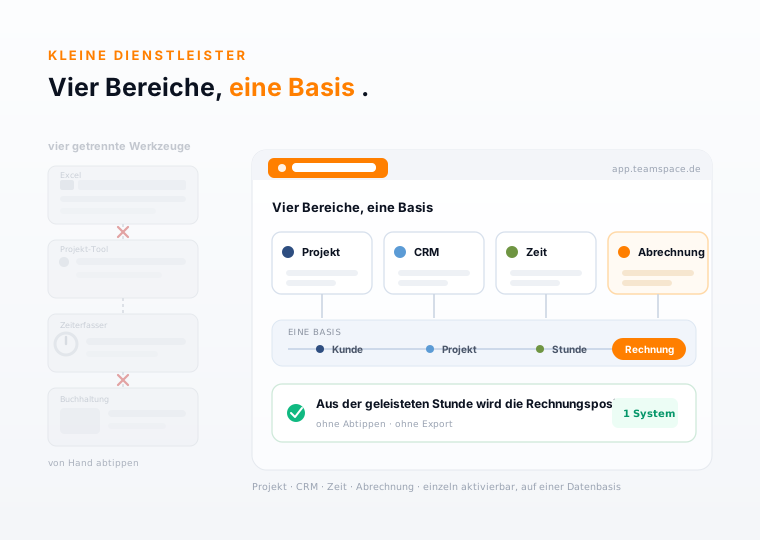
Bright scene in the teamspace style. On the left, greyed out, four separate entry-level tools of a small professional services firm (Excel, a project tool, a time tracker, the accounts) with broken connectors and a note that the gaps are bridged by retyping by hand. On the right, in bright light, a teamspace window in which four module cards (project, CRM, time, billing) dock onto a shared foundation of customer, project, hour and invoice, and the hour becomes the invoice line.

Four areas, one foundation

One record gives rise to the project, the hour and the invoice.

Customer, project, hour and invoice sit on the same record. Accept the quote and you have the project; log the hour and you have the invoice line. No retyping between four programmes.

Gemeinsame Basis
Akte Müller & Partner GmbH

Projekt

Website-Relaunch

Auftrag

Tagessatz + Pauschale

PROJEKT

Projektmanagement

Website-Relaunch

Plan 40 h · Ist 32 h

KUNDE

CRM

Angebot angenommen

wird zu Projekt

STUNDE

Zeiterfassung

heute gebucht

6,5 h · abrechenbar

RECHNUNG

Abrechnung

Rechnungsvorschlag

aus 32 h · ZUGFeRD

one login · one set of data · four areas

Between the tools

Between four tools the small piece of work gets lost.

  • The hour sits in the time tracker, the invoice in the accounts, and in between it is retyped.
  • The short extra task done on the side lands in no project and on no invoice.
  • Customer data is held three times over: in the CRM, in the project tool and in the accounts.
  • Each tool has its own login, its own update and its own contract.

teamspace brings these four areas together in one system, so that no piece of work is left lying between the tools.

The four areas

The four areas your business depends on.

A small professional services firm does not need ten specialist tools, but the four areas its money depends on, cleanly connected.

Project management

Main project, sub-project and work package map every engagement. Plan and actuals stand up to date from the logged hours, not from a second list.

Learn more

CRM

Organisation, contact and case sit on one record. An accepted quote becomes a project with budget and team in one click.

Learn more

Time tracking

Hours land on project and phase the same day, by stopwatch, weekly grid or mobile. Every entry carries its category, billable or internal.

Learn more

Billing

Checked hours, flat rates and travel costs produce the invoice draft. E-invoicing and DATEV handover with no extra tool.

Learn more

Comparison

Four separate tools or one connected system.

Where an end-to-end system differs from a patchwork of Excel, a separate time tracker and standalone accounts.

Feature

Four separate tools

teamspace

Recommended
A logged hour becomes an invoice line without an export
manual
Customer and project set up once, connected across all four areas
The small extra task lands on the project rather than nowhere
Day rate, fixed price, flat rate and maintenance in one document workflow
scattered
E-invoicing (ZUGFeRD, XRechnung) and DATEV handover with no extra tool
extra tool
One login instead of four, no interface contract
Start small, extend later with no data migration

Where it fits

Who teamspace suits, and who it does not.

Less of a fit

  • Pure to-do or task teams with no billing needs.
  • Stock control, online shops or trade with warehousing.
  • Production and manufacturing with bills of materials and material planning.
  • Single-user use with no team, projects or time records.
Recommended

A good fit

  • Project-based professional services firms that bill their work to the client.
  • Teams of roughly 10 to 100 employees with several parallel projects.
  • Firms with mixed billing of day rate, fixed price, flat rate and maintenance.
  • Small firms that want to start without an IT team of their own.

What matters

What software for small service businesses has to be able to do.

Software for small service businesses connects project, customer, hour and invoice in one system, so that a logged hour turns into an invoice with no detour. It is built for project-based professional services firms with roughly ten to a hundred employees that bill their work to the client.

Four things decide whether such a system holds up in everyday use:

  • A shared foundation: customer, project and hour belong together, without a CSV bridge between four programmes.
  • The hour becomes the invoice: checked times, flat rates and travel costs produce the invoice draft.
  • One billing for everything: day rate, fixed price, flat rate and maintenance run in one document workflow.
  • Grows with you: start small, add a module later, without setting the data up again.
The core processes of a professional services firm

Industries

Which professional services firms teamspace brings templates for.

teamspace is built above all for consultancies and IT service providers, and beyond that it covers four further industries with templates of their own.

Management consultancies

Engagement structure, fee models, consulting days and utilisation across teams and locations.

Industry page

IT service providers

Projects and ongoing operations in one system: every hour on the right contract, maintenance with SLA.

Industry page

IT systems house

Projects, managed services, tickets and maintenance contracts on one platform, with SLA and automatic renewal.

Industry page

Agencies

Fees plus external costs, the budget as one unit and a pool of permanent and freelance staff.

Industry page

Architecture and engineering practices

Planning at the HOAI fee, service phases, hour accounts and variations.

Industry page

Rollout in stages

You start small, with the area that hurts today.

Nobody rolls everything out at once. You switch on the modules that matter today and extend later. Data and configurations grow with you, and a later extension is not a data migration.

  1. 1

    First meeting

    In 15 to 30 minutes we work out which areas make sense first for your size and industry.

  2. 2

    Basic setup

    We take master and project data across from Excel or your previous tools, usually within a few days.

  3. 3

    First module live

    A team often starts with time tracking or projects, with a dedicated contact guiding the start.

  4. 4

    Extend step by step

    CRM, billing or service desk are added when they are needed, with no new data migration.

“Time tracking is far simpler and more convenient than in Excel.”

kwsoft records its team's working time in teamspace, instead of keeping hours in Excel.
kwsoft

Why teamspace

Three reasons small firms stay with teamspace.

teamspace is not a bet on growth, but software that keeps its customers. Three points carry that, small firms above all.

  • From Darmstadt, run in Frankfurt: we have developed teamspace since 1999 without outside capital, hosted in an ISO 27001 certified data centre in Frankfurt am Main.
  • You pay for what you use: billing is per activated user and module, with no setup fee, on an edition that grows with the team.
  • A fit or not, said plainly: where teamspace does not hold up, you hear it in the first meeting, not after the purchase.

teamspace at a glance

No estimates, but the key facts on origin, scope and getting started.

1999
developed in Darmstadt

for over 25 years, without outside capital

9
modules in one suite

each switched on individually

from €7
per user and month

annual term, no setup fee

1
system instead of tool sprawl

one login, one set of reports

What it costs

Pricing that grows with the team.

teamspace is billed per activated user and month, from €7 on an annual term. The prices quoted are annual prices; half-yearly, quarterly or monthly terms are possible for a surcharge. There is no setup fee, and you pay only for the modules you have switched on.

  • Three editions from light to enterprise, growing with feature scope and team size.
  • No setup fee, with data transfer from Excel or legacy systems at a fixed price on request.
  • Which edition fits, we work out against your size and industry in the first meeting.
See pricing

In 15 minutes

Is teamspace right for your professional services firm?

Bring a typical project and the way you bill today. In 15 to 30 minutes you will hear an assessment of whether teamspace fits and which module would make a sensible start.

Frequently asked questions about software for small service businesses

Which software suits a service business of 30 employees for project management, CRM, time tracking and billing?
teamspace is built for exactly this profile: an integrated solution that connects project management, CRM, time tracking and billing on one set of data. You maintain customer and project once, logged hours become an invoice without an export, and utilisation and margin stand up to date. teamspace is designed for project-based professional services firms with roughly 10 to 100 employees.
Is an integrated solution worth it over individual tools for time tracking, CRM and invoicing?
As soon as several people work on the same customers and projects, switching between separate tools costs time and creates duplicate, often outdated data. An integrated solution saves the export between the tools, keeps the data consistent and makes utilisation and margin visible without working through lists. For very small teams with no billing needs, a single tool can be enough.
For which companies is teamspace not the right choice?
teamspace is tailored to project-based professional services firms. It is less of a fit for pure to-do teams with no billing, for stock control, online shops and trade with warehousing, and for production and manufacturing with bills of materials. Materials management and warehouse logic are deliberately missing there, because teamspace focuses on project, service and billing.
What does teamspace cost for a small service business?
Billing is per activated user and month, from €7 on an annual term, with no setup fee. There are three editions that grow with feature scope and team size. Which edition fits, we discuss against your size and industry in the first meeting. Details are on the pricing page.
How long does the rollout take?
Basic setup usually takes a few days. We take master and project data across from Excel or your previous tools, at a fixed price on request. Many teams are productive within four to six weeks and start with the module that hurts most today.
Is the data hosted in Germany?
Yes. teamspace runs in an ISO 27001 certified data centre in Frankfurt am Main, GDPR-compliant and with a data processing agreement. Data is processed solely within the EU. It is the data centre that is certified, not teamspace itself. The contracting party is 5 POINT AG, a German public limited company based in Darmstadt.
Can we start small and extend later?
Yes. You first switch on the modules that matter today, usually time tracking or projects, and add CRM, billing or service desk later. Data and configurations grow with you, and a later extension is not a data migration.

First meeting

Settled in 15 minutes: whether teamspace is right for you.

In the 15 to 30 minute first meeting we look at your projects, your billing and your size and tell you whether teamspace fits and where a start makes sense.