
How do we win good, profitable new work steadily and for the long term?
01Answered by the Sales process
Pipeline, opportunities and forecast in one view, with every enquiry kept on the contact.
To the sales funnelThe sales process decides which work will carry the firm six months from now. teamspace brings pipeline, activities, clients and forecast together in one view and makes the maturity measurable.
How do we win good, profitable new work steadily and for the long term?
01Answered by the Sales process
Pipeline, opportunities and forecast in one view, with every enquiry kept on the contact.
To the sales funnelWhich clients are worth the most to us?
01Answered by the Sales process
teamspace classifies contacts automatically into A, B and C. The class shows in CRM, on incoming calls and in email.
To the ABC classificationIs an opportunity being left behind somewhere?
01Answered by the Sales process
Reminders prompt the follow-up, and teamspace warns when nothing has happened with a contact for too long.
To activity steeringWhat is a sales process?
By the sales process we mean every step a professional services firm takes to turn an enquiry into signed work: capturing the lead, qualifying the opportunity, writing the proposal, following up and closing. It also covers the less comfortable question of which clients and opportunities deserve your time at all. The process ends where the won deal moves into delivery as a project.
In many consultancies and IT firms, the managing director sells on the side and the pipeline lives in their head. That works until a quarter runs dry and nobody saw it coming. Sales only becomes a process once every opportunity has a stage, a value and an owner. Further down you can see what that looks like in teamspace, and which number warns you about an empty pipeline before order intake does.
Where it gets stuck
Only at quarter end does it become clear where sales really stands. By then it is usually too late to correct course.
An effective sales dashboard combines pipeline, deal quality and activities. Each dimension answers a different question, together they form a complete picture.
Dimension 1
How many opportunities sit in which stage? What revenue is within reach? How does the pipeline evolve over time? A look ahead at future revenue.
Dimension 2
How many enquiries become engagements? At which transition are most opportunities lost? A look back at the efficiency of sales.
Dimension 3
How active is sales? When was the last contact with important people? A look at the quality of client relationships today.
A sales process is a repeatable sequence of stages that turns an enquiry into an engaged client. In teamspace every opportunity moves through five stages, switching from module to module with no media break, from the first contact in CRM to the finished project.
CRM
The enquiry comes in through a campaign, a referral or proactive outreach and is recorded in CRM, with source, contact and need.
Opportunity
The enquiry becomes a scored opportunity with a stage, a target value, a probability and an owner in the sales funnel.
Proposal management
The proposal is generated from CRM with templates, an item catalogue and price lists, and stays linked to the opportunity.
Activities
Meetings, queries and adjustments are logged as activities. Reminders make sure no negotiation drifts away.
Order and project
A won opportunity becomes an order in one click, and from that a project. The data flows into delivery without being entered again.
The steering object
In the sales funnel every opportunity has a stage, a target value and a probability. teamspace computes the current value from those and condenses the stages into a forecast. In the end the won opportunity becomes an order in one click.
24 opps · target 320 k €
11 opps · target 210 k €
5 opps · target 90 k €
The analysis
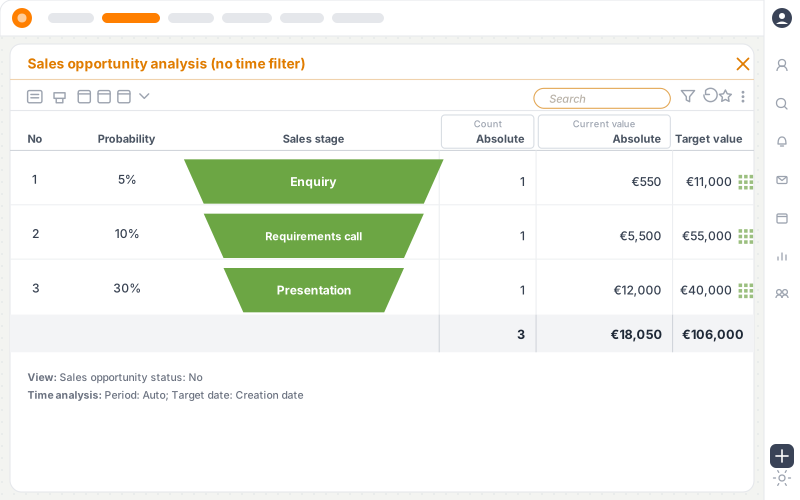
The opportunity analysis shows the funnel as it stands right now: per stage the probability, the number of opportunities, the current value and the target value, with the totals underneath.
You see which stage holds the most prospects right now and what value sits in each.
Just one period, a particular target value, one client or one key account manager: filters and assignments tailor the report.
Funnel, forecast and the sales analyses belong to the enterprise edition.
ABC classification
Close analysis
The KPIs that count are derived from the sales data. Each one gets a status light with individually configurable target values in green, amber and red.
Sum of the open opportunities, optionally weighted by probability. Shows how much revenue is actually within reach.
Every opportunity feeds in with its close probability. That gives a more realistic revenue expectation than the plain pipeline total.
Ratio of opportunities to won orders. Makes visible how reliably enquiries turn into orders.
Open opportunities with no reminder planned. The earliest sign that something is no longer being actively sold, only administered.
Documented sales activities per handler. The activity analysis answers whether the team is actively selling or just administering.
Days since the last documented contact with important people. teamspace warns when a relationship has been dormant too long.
The decisive difference sits in the data model and in activity steering.
| Feature | Classic (CRM and spreadsheets) | teamspace sales process |
|---|---|---|
| Pipeline | Exported to a spreadsheet, consolidated by hand, often a week old | Live in the system, sorted by stage, value and owner |
| Forecast | Gut feel and a spreadsheet estimate, different from person to person | Target value times probability, condensed across the funnel into a forecast |
| Activities | In Outlook and a notebook, with no link to the opportunity | Linked to opportunity, client and VIP, fully documented |
| Client value | Gut feel, not available across the system | ABC classification in CRM, visible on calls and in email |
| Handover to delivery | Manual switch to the project tool, double data entry | A won opportunity becomes an order in one click, and from that a project |
Where you stand
In a 15 to 30 minute requirements call we look at your sales funnel together and place it on the maturity model.
Activity steering
Not every firm has the same degree of structure and automation. The maturity shows how systematically sales is actually steered, from unplanned to fully automated.
No structured sales process. Leads are tracked unsystematically and a central view of opportunities is missing.
First structure through spreadsheet lists. Opportunities are partly documented, but not maintained consistently.
The process with stages and pipeline is defined. Opportunities are recorded systematically, but without end-to-end integration.
A CRM is in use. Pipeline, activities and proposals are managed with system support, first analyses and forecasts appear.
Automated analyses, forecast and reminders. Activities, campaigns and ABC classification mesh together.
End-to-end steering with automatic prioritisation and prompts, from sales through the project to billing, with live dashboards.
The sales process runs on software that has been in daily use for years, operated geo-redundantly and in Germany.
20,000+
active users
in daily use across the DACH region
around 400
clients
mostly service providers and mid-market firms
ISO 27001
data centre in Frankfurt
operated geo-redundantly, daily backups
EU
data processing
encrypted transmission via TLS
What matters
The sales process draws on several modules, all on one shared data model.
Clients, contacts, VIP structures and history. The foundation of every activity.
Learn morePipeline steering with stage, value, probability and ownership. The central steering object.
Learn moreProposals with templates, an item catalogue and price lists, with a transition to the order.
Learn moreContacts, reminders and follow-ups. Relationship steering in one view.
Learn moreLead sources, mail sequences and mail merges, with a transition into the opportunity.
Learn moreForecast, pipeline reports and the sales dashboard with status-light logic.
Learn more“Our staff appreciate how simple the system is.”

“Staff in both support and project planning can see orders and invoices. That was not possible before.”

Sales is just one of seven core processes. Here are the other six:
How do we deliver projects reliably, on time and profitably?
How do we turn work into revenue quickly and in full?
How do we keep costs and liquidity under control at all times?
How do we serve clients by value and with high quality?
How do we steer capacity, skills and motivation optimally?
How do we lead the firm on current data?
In a 15 to 30 minute requirements call we place your sales process on the maturity model and show which steps make the next level realistically reachable.