
How do we win good, profitable new work steadily and for the long term?
01Answered by the Sales process
Pipeline, opportunities and forecast in one view, with every enquiry kept on the contact.
To the Sales processCore processes are the workflows through which a firm earns its money. A professional services firm has seven, and each one pursues a goal. You do not have to tackle them all at once: you start where it matters most for you and improve your firm one process at a time.

How do we win good, profitable new work steadily and for the long term?
01Answered by the Sales process
Pipeline, opportunities and forecast in one view, with every enquiry kept on the contact.
To the Sales processHow do we deliver projects reliably, on time and profitably?
02Answered by the Project delivery process
Plan vs actual and project margin are up to date every day, not only at the end.
To the Project delivery processHow do we turn work into revenue quickly and completely?
03Answered by the Billing process
Logged hours land on the invoice without anyone retyping them.
To the Billing processHow do we keep costs and liquidity under control at all times?
04Answered by the Cost control process
Costs, contribution margins and cash planning come together every day.
To the Cost control processHow do we look after clients quickly, competently and by value?
05Answered by the Customer care process
Requests are prioritised by client value, with SLA time left as a traffic light on the ticket.
To the Customer care processHow do we steer capacity, skills and motivation well?
06Answered by the Workforce process
Availability, skills and utilisation side by side before you staff anyone.
To the Workforce processHow do we lead the firm on current data?
07Answered by Business steering
Eight KPIs with their own traffic lights in one management dashboard, fed by every process.
To Business steeringWhether consultancy, IT service provider or engineering office: the business runs on the same core processes, from first contact to paid invoice. teamspace maps them in one system and makes each process individually steerable. Pick the area below that pinches most right now.
A professional services firm has seven core processes, and each pursues a goal: sales, project delivery, billing and cost control carry value creation, customer care and the workforce process carry the people, and business steering brings all six together.
A process map shows these processes at a glance, on three levels: steering at the top, value creation from client to cash in the middle, and at the bottom the processes that carry it.
Nobody has to improve all seven at once. You begin with the process whose goal matters most today, then move on to the next.
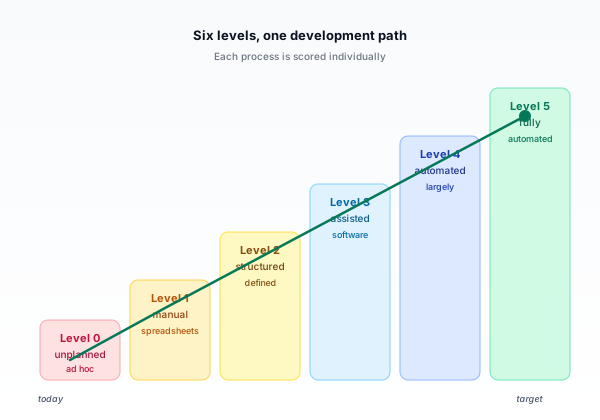
How far a process has come is shown by a maturity model with six automation levels, from unplanned to fully automated.
The maturity profile records, at a given date, where each process stands and which level comes next. Kept up to date, it shows how the firm develops over the years. You can do the assessment yourself or with us in a first call.
Seven processes, seven goals
The goals are the questions a professional services firm has to keep answering. Whichever matters most right now decides where you start.
01 · Sales process
The answer in teamspace
The sales process brings pipeline, opportunities, activities and ABC classification into one system. Every enquiry stays on the contact, and the forecast comes from the opportunities rather than from gut feeling.
How you see progress: Order intake and pipeline value in the management dashboard.
02 · Project delivery process
The answer in teamspace
The project delivery process keeps plan, hours and margin together every day and flags deviations early, instead of only showing them at close.
How you see progress: Project margin and plan vs actual per project, every day.
03 · Billing process
The answer in teamspace
The billing process connects time capture, billing rules and invoicing. Logged hours land on the invoice without anyone retyping them, and the revenue forecast shows what is still to come.
How you see progress: Actual revenue and revenue forecast.
04 · Cost control process
The answer in teamspace
The cost control process brings fixed costs, project costs, contribution margins and cash planning together. Every cost lands on the project the same day, and every receipt goes through an approval before it is paid.
How you see progress: Liquidity and contribution margin per project.
05 · Customer care process
The answer in teamspace
The customer care process prioritises requests by client value rather than by volume. Tickets, SLA and communication sit in one view, and a looming SLA breach is flagged, not hidden.
How you see progress: Agreed response and resolution times are measured, not just agreed.
06 · Workforce process
The answer in teamspace
The workforce process connects availability, skills, utilisation and pay, so the right people work on the right projects.
How you see progress: Utilisation and revenue per head.
07 · Business steering
The answer in teamspace
Business steering compresses the data of the six operational processes into eight metrics in one cockpit for the leadership, each with a leading question and its own threshold logic.
How you see progress: All eight metrics, each with its own traffic light.
Which goal matters most for you right now? Assess it yourself or together with us in a first call.
Start individually
Rebuilding an entire firm in one move rarely works. The process-oriented approach splits the complex task instead: each of the seven processes is examined and improved on its own. In sum the firm as a whole becomes more steerable and more economical, without anyone having to carry everything at once.
This happens step by step, not as a big bang. You start where the lever is largest, and the day-to-day business keeps running the whole time. So the rollout does not tie the firm up for three to six months. It stays one controllable step after another, and you close no doors for later.
And everyone knows where they stand. Each firm keeps its own profile that records, at a given date, how far each process is supported today and which level comes next. Through the automation levels you see the current state and the next possible step at any time. How closely we accompany that path is your call: sometimes intensively, sometimes more gently, depending on what else is on your plate.
Maturity profile
Example, level per process
2026: Baseline set
Every process has its level. Now you decide which goal comes first.
2027: Focus set
How do we turn work into revenue quickly and completely?
How do we deliver projects reliably, on time and profitably?
2028: Next step
How do we win good, profitable new work steadily and for the long term?
How do we keep costs and liquidity under control at all times?
2029: Further developed
How do we steer capacity, skills and motivation well?
How do we lead the firm on current data?
The path through the processes
Not a project with an end date, but a cycle: take stock, choose a goal, move up a level, record it, then on to the next process.
Maturity
Each of the seven processes gets its level on the maturity model, recorded in the profile.
Focus
You pick the process whose goal matters most today, usually where the lever is largest.
Implement
The process moves up a level in small, controllable steps. Day-to-day business keeps running.
Record
The new state goes into the profile, with a date. That way the development over the years becomes visible.
Continue
The next process comes in. Data and configuration grow with you, nothing is ruled out.
Where you stand
In a first call we go through your processes, place the most pressing one and name the biggest lever.
Maturity model
A maturity model describes in levels how far a process is defined, supported and automated. Not every firm can reach fully automated processes overnight. We rate each process on a six-step model that exposes a realistic development path.
Processes are not defined. Activities happen ad hoc. Success depends on individuals stepping up.
Tasks are done in a structured way, but without system support. Spreadsheets are the norm.
Processes are described and applied systematically. Data still lives in separate places.
Software actively supports the process. First reports, dashboards and forecasts become possible.
Reports, reminders and handovers run mostly automatically. Processes are integrated with each other.
Processes run almost entirely on their own. Prioritisation, forecasts and escalations are system-supported in real time.
Maturity check
Many firms overestimate their maturity. 'We have a CRM' or 'we have reports' says nothing about real steerability. These four questions help you assess each process honestly.
Are all relevant items captured systematically, or only the ones somebody happened to remember?
Is the data up to date and trustworthy at any moment, or does it reflect last month's reality?
Are opportunities, activities, projects, hours and invoices linked, or do they live in separate tools?
Does the system actively support with forecasts, reminders and prioritisation, or does everything need manual review?
Where you stand
Every firm gets its own profile. It records, at a given date, how far each process is supported today and which level should be reached next. So you can see at any time where you stand and what is still possible.
Sales
Project delivery
Billing
Cost control
Customer care
Workforce
Business steering
Working long term
A profile is of little use if nobody ever updates it. There is already a suitable occasion for that: the audit workshop, four hours remote, once a year. It covers more than the processes, and taking stock is one of the elements you can choose to include. If you do, you assess the seven processes yourself and we put that assessment into context against what we see at comparable firms. What comes out is a single page: where each process stands, what the next step is, and what it takes.
The workshop is included in standard and premium support, once a year. With basic support you can book it as well, charged by time spent. Neither the workshop nor the stocktaking inside it is compulsory: if you simply want to use the software, that is entirely fine.
For many firms that is exactly what sets it apart from other systems. Modules can be compared and, eventually, copied. Software that tells you once a year where your business stands and what the next sensible step would be is something other than a feature list.
Acceptance was high from the start and has stayed high.
Ida Kaiser, Managing Director, B.B.S.M. mbH

One data model
A question can only be answered reliably if the data behind it fits together. In teamspace every piece of information hangs on the same item: the quote becomes the project, the hour becomes the invoice, the ticket becomes billing.
CRM
The client accepts the quote. It becomes a project automatically.
Project management
The project starts with budget and team. Every hour logged counts against the budget.
Time tracking
Tracked hours land on the project and become the invoice basis. No CSV export in between.
Invoicing software
The logged hours appear on the invoice, nobody retypes them. If needed, it goes out as ZUGFeRD or XRechnung.
Ticket system
Whether it arrives through the customer portal, Outlook or a Teams call, the request lands as a ticket in the service desk.
Ticket system
Service tickets capture effort directly, no second time sheet needed.
Invoicing software
The effort is drawn from the client's hour pool or billed.
How you measure the goals
Above the six operational processes sits a steering level. It compresses their data into eight metrics, each with a leading question and its own threshold logic. It is not the single number that decides, but how they play together.
How is future revenue developing?
How much potential sits in sales?
How is business doing right now?
Where is revenue heading?
Are we earning on our projects?
Are we using resources well?
How productive is the firm?
Are we financially stable?
Process map
A professional services firm earns its money by selling time and expertise. Seven processes map that value creation in full. Sales wins the engagements, project delivery delivers them, billing turns work into revenue, cost control protects the margin. Customer care and workforce management hold the people on both sides of the work. And business steering joins the six operational processes into one view for the leadership.
In process management this is drawn as a process map with three levels: management processes at the top, core processes in the middle, supporting processes at the bottom. Our map follows the same logic and calls the levels steering, value creation and people. We still count customer care and workforce management as core processes, because without them a services firm delivers nothing it could bill.
Seven processes thus cover the whole way from acquisition to liquidity and still stay manageable. Define twenty and you lose steerability; define three and you miss the key levers. What matters is less the number of tools than how they connect: only when every process draws its data from the same set does a collection of tools become a steering system.
Steering
07 Business steeringValue creation
Three overviews
The same software, sorted differently: by function or by industry.
The nine teamspace modules at a glance, from time tracking to quality management.
Learn moreHow teamspace fits consultancies, IT service providers, system houses, agencies and engineering offices.
Learn moreFirst call
In a 30-minute first call we score your seven processes against the maturity model and show where the largest potential sits.