teamspace

Order processing software: from order via delivery note to the final invoice.

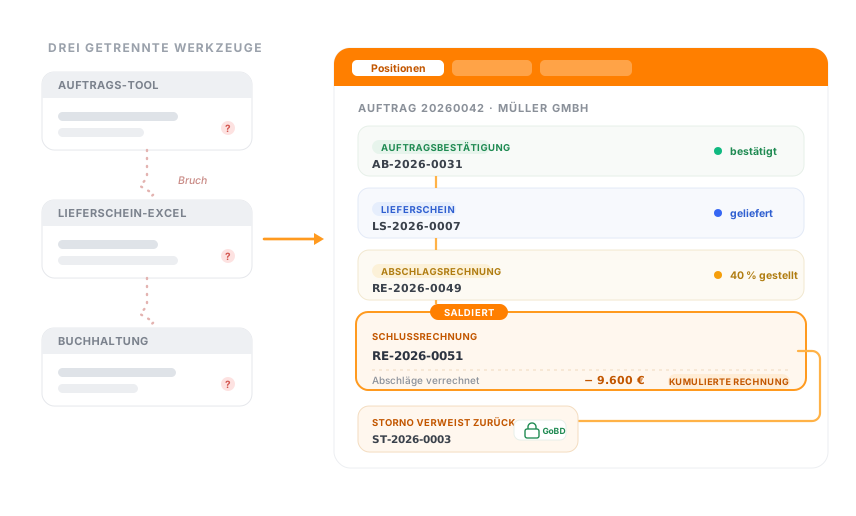
Order, delivery note and invoice run in one chain, not in three separate tools. The accepted quote becomes the order, from it the delivery note and the offset final invoice.

teamspace order processing: on the left three separate tools for order, delivery note and invoice with a break between them, on the right the same documents as one connected chain of order confirmation, delivery note, down payment and offset final invoice.

Does this sound familiar?

The order breaks apart between the tools.

  • The order confirmation lives in one program, the delivery note in the second, the invoice in the third.
  • Which partial invoice has already been issued is something nobody knows without asking around.
  • When a credit note is raised, the clean trail of who corrected what and when is missing.
  • At month end someone pieces the chain together by hand.

The pain is not the single invoice, but the broken chain in between.

Three building blocks

What order processing covers

Order confirmation, delivery and final invoice mesh together instead of sitting in separate tools.

Order

Order confirmation from the quote

When a quote is accepted, the order is created with an order confirmation. Terms, delivery dates and payment terms are part of it.

  • From the accepted quote with one click
  • A project straight from the order if you want

Delivery

Delivery note and partial invoices

Delivered items get a delivery note as a document type of their own, a service records the released hour. Partial invoices run via the payment plan.

  • Delivery note as a document type of its own
  • Partial and down payment invoice via the payment plan

Completion

Final invoice and credit note

The final invoice offsets the down payments against each other. A credit note references the original invoice, with reason, editor and timestamp.

  • Down payments offset in the final invoice
  • Credit note with reference and GoBD history

The document chain of an order

From the confirmed order to the offset final invoice, in one chain.

The accepted quote becomes the order, from it the delivery note for delivered items and the down payment invoices. The final invoice offsets the down payments, the credit note references its invoice and stays for ten years in GoBD mode.

  1. Order confirmation 01

    AB-2026-0044

    confirmed
  2. Delivery note 02

    LS-2026-0019

    delivered
  3. Advance invoice 03

    RE-2026-0067

    40 % issued
  4. saldiert
    Final invoice 04

    RE-2026-0071

    advances netted
    Advances netted − 7.200 €
    cumulative statement

Cancellation refers back

ST-2026-0005 · refers to RE-2026-0071

GoBD mode · 10 years · not deletable
Reason for cancellationEditorTimestamp

Every document knows its predecessor; the cancellation knows its invoice.

From quote to order

The accepted quote becomes the order, without retyping.

When the customer says yes, the quote becomes the order with one click. The line items move along, the status switches to ordered, and if you want the project with time logging is created straight away.

This way the chain begins at a point where the data already exists.

  • One click: the quote becomes the order with an order confirmation.
  • Terms carried over: hourly rates, delivery date and payment term are in the order.
  • Project on request: order line items become work packages.
Create quotes

Partial and final invoice

Down payments run via the payment plan, the final invoice offsets them.

Per order you set a payment plan: down payment, percentage, single line item or final invoice. The final invoice is the remaining amount, the down payments are offset, and a cumulative invoice shows the overall position if you want.

How the invoice is calculated from each line item is shown by order billing.

  • Four types in the payment plan: down payment, percentage, line item and final invoice.
  • Offset: the final invoice offsets all down payments against each other.
  • Cumulative invoice: the overall position of the order if you want.
Order billing

Media break or chain

Three separate tools or one chain.

Order, delivery and invoice separate

  • Order confirmation, delivery note and invoice live in three programs.
  • Data is captured anew for every step.
  • Which partial invoice is open is settled by a query.
  • The credit note happens without a clean trail to the invoice.
  • At month end someone reconstructs the chain by hand.
Recommended

teamspace as one chain

  • Order confirmation, delivery note and invoice hang on the same order.
  • The quote becomes the order, without retyping.
  • Every document shows its status, from order to payment.
  • The credit note references its invoice, with reason and timestamp.
  • The final invoice offsets the down payments automatically.

The mixed order

Service and delivered item in one order.

Concept, delivery by time and material, a maintenance flat rate and delivered licences hang on the same order, each line item with its own billing method. Four statuses run in parallel: order, delivery, invoice and payment.

PositionenAbrechnungNachkalkulationHistorie
Auftrag 20260042 · Müller GmbH
Auftrag laufend Lieferung in Teilen Rechnung Abschlag Zahlung offen

Konzept & Umsetzung

Konzeptphase 12.000 €
Umsetzung · Seniorsatz 9.280 €

Wartung & Hardware

Wartungspauschale 480 €
Hardware · 4 Lizenzen 3.600 €

Auftrag

25.360 €

beauftragt

Projekt-Ist

22.910 €

Ist gebucht

Rechnung

21.480 €

gestellt

Die Nachkalkulation vergleicht alle drei, bis auf die Position.

From order to project

The order becomes the project on request.

For larger orders the line items become a project with work packages. Staff log their hours against it, and the released hour serves as proof of delivery for a service.

The full order life cycle is shown by order management.

  • Line items become work packages: with budget and owners.
  • Hours on the project: logged via time tracking.
  • Hour release as proof: a service instead of a delivery note.
Order management

Credit note with a trail

A credit note references its invoice and stays traceable.

A credit note references the original invoice, with credit reason, editor and timestamp. teamspace credits in full; for a partial correction an invoice correction is created as a document of its own.

In activated GoBD mode, invoices and credit notes stay for ten years and can no longer be deleted. More on this in the invoicing software.

  • Back reference: the credit note knows its invoice.
  • Mandatory details: credit reason, editor and timestamp.
  • GoBD mode: kept for ten years, no longer deletable.
Invoicing software

Deeper into the modules

The building blocks around order processing

Order processing tells the path. The mechanics behind it sit in the individual modules.

Order management

The full order life cycle with line items, status and post-calculation.

Order billing

How the invoice emerges from the line items: billing methods and invoice run.

E-invoicing

ZUGFeRD and XRechnung emerge without an extra tool, as standard.

Dunning

Open items, dunning levels and late payment interest run automatically.

Project billing

Logged hours become the invoice, fixed price and time and material in parallel.

What matters

What an order processing software has to do

An order processing software runs an order from confirmation to the paid final invoice in one system. It keeps order confirmation, delivery note and invoice on the same thread, so no step is lost in a second tool.

Four things decide whether the run holds:

  • One document chain: every document knows its predecessor, from order to final invoice.
  • Delivery note as a document type of its own: delivered item and service cleanly recorded.
  • Offset final invoice: down payments and partial invoices are offset against each other.
  • Traceable credit note: reference to the invoice, kept for ten years in GoBD mode.

Who it's for

Where order processing really takes hold

Professional services firms with mixed orders of service and delivery run the workflow a little differently per sector.

Management consultancies

Engagements with down payments and fee models, from order to final invoice.

Industry page

IT service providers

Project, maintenance and ticket on the same order, every hour on the right contract.

Industry page

IT systems house

Hardware with delivery note and maintenance as a recurring contract in one order.

Industry page

Architecture and engineering practices

Down payments by work phase, the final invoice offsets them cleanly.

Industry page

A quick chat

We look at your order workflow in 15 minutes.

In the first call we clarify how your path from order via delivery note to final invoice is mapped in teamspace.

Why teamspace

Three things you can rely on

Made in Germany

Developed in Darmstadt, operated in two geo-redundant, ISO 27001 certified data centres in Frankfurt am Main.

On the market since 1999

Over 25 years, more than 20,000 active users and around 400 customers in the DACH region, self-funded.

GoBD mode over ten years

In activated GoBD mode, invoices and credit notes stay for ten years and can no longer be deleted.

“Staff in both support and project planning can see orders and invoices. That was not possible before.”

A+W Software GmbH: support and project engineering see orders and invoices in the same system, instead of in separate silo solutions.
A+W Software GmbH

Frequently asked questions on order processing

What distinguishes order processing from order billing?
Order processing runs the path and the documents: order confirmation, delivery note and credit note. Order billing shows how the invoice emerges from the individual line items, with billing methods, invoice run and post-calculation.
How do partial and final invoices work?
Via the payment plan with the four types down payment, percentage, line item and final invoice. The final invoice is the remaining amount, the down payments are offset. A cumulative invoice shows the overall position of the order if you want.
How does a credit note work?
A credit note references the original invoice, with credit reason, editor and timestamp. teamspace credits in full; for a partial correction there is the invoice correction as a document of its own. In activated GoBD mode everything stays for ten years.
Can a service and a delivered item run in one order?
Yes. A mixed order runs a service (with hourly rate or fixed price) and delivered items (with delivery note) side by side, in one order and one final invoice.
Do the invoices go out as e-invoices?
Yes. ZUGFeRD and XRechnung emerge without an extra tool. Accounting data goes via the DATEV certified interface to DATEV Unternehmen online. More on this under e-invoicing.

Let's talk about your order workflow.

In 15 to 30 minutes we clarify how order, delivery note and final invoice come together in teamspace.