
1
Fixed price, T&M and flat rates in parallel
Per order you can run fixed-price components, time-and-materials hours and recurring flat rates simultaneously. Hours booked on the right contract type, the period invoice combines them all.
With teamspace order billing you bill fixed-price, time-and-materials and flat-rate orders in one logic. Hours, material costs and travel flow into the invoice draft automatically. ZUGFeRD and XRechnung are standard, DATEV handover runs without CSV exports. Part of teamspace invoicing software, no module surcharge.
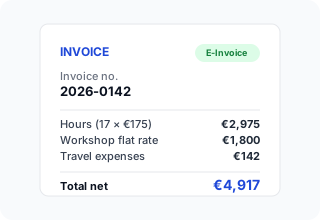
Per order you can run fixed-price components, time-and-materials hours and recurring flat rates simultaneously. Hours booked on the right contract type, the period invoice combines them all.
Logged and approved hours, material costs and travel turn into an invoice draft automatically. One click to the invoice, ZUGFeRD or XRechnung to the customer, parallel DATEV export to finance.
Per order teamspace generates an activity record as PDF or XRechnung attachment. Exactly the fields the customer needs for sign-off, no manual Excel lists at month-end.
Fixed-price phase, T&M hours, maintenance flat rate, hardware position. Per component conditions, rates and period rhythm.
Staff log hours on the right component, on mobile or desktop. Material costs, travel and subcontractor hours directly on the order.
Team leads approve hours, corrections recorded in the audit trail. Only approved hours go into the invoice.
Period close: from approved hours, flat rates and travel an invoice draft is created in one click. Review, correct if needed, approve.
Send as PDF, ZUGFeRD or XRechnung. DATEV handover for accounting. Automatic dunning on payment delay.
Order billing software turns delivered work into an invoice. That sounds simple, but in service firm reality it is complex: per order multiple contract types often run in parallel (fixed-price concept, T&M implementation, maintenance flat rate), hours have to be approved, material costs and travel come separately, the activity record is contractual.
teamspace bundles this in one platform. From logged hours, flat rates, material costs and travel an invoice draft emerges in one click, with activity record as attachment, ZUGFeRD or XRechnung to the customer and DATEV handover to accounting.
In classic setups, fixed-price orders, T&M hours and maintenance flat rates often live in separate tools. Consolidation at period-end costs hours of manual Excel work. teamspace runs them in one logic with all components configurable per order: fixed-price components with order sum and down payment plan, T&M components with rates per role, flat rates with period rhythm and hour quota, hardware and licence positions, travel with receipt photos, subcontractor hours with separate rates for the margin calculation.
The period-end invoice combines all components in one document with clear breakdown per component.
The leverage of integrated order billing lies in automatic intake. Hours staff book today on the order are part of the period-end invoice draft tomorrow. Without CSV export, without Excel transfer, without manual entry. Weekly or monthly approval by team leads, corrections in the audit trail. Invoice draft generated automatically, review by accounting in preview mode, approval and send-out as PDF, ZUGFeRD or XRechnung.
Activity records are often contractual in B2B service work, especially in consulting and IT engagements. teamspace generates them as PDF attachment to the invoice, XRechnung attachment in structured format, table per order with date, employee, activity, hours, filterable by order, period, employee, audit-proof linked to the time-tracking audit trail.
teamspace doesn’t replace accounting software, it integrates: DATEV in standard format, Lexware and Sage via standard connectors, incoming invoices captured digitally and pushed to DATEV, payroll preparation via DATEV LODAS and LuG.
Order billing touches accounting-relevant data. teamspace is with activatable GoBD mode for retention, hosted in an ISO-27001-certified data centre for information security, GDPR compliant with standard data processing agreement, hosted exclusively in Frankfurt am Main, with audit trail on every correction and lockable closed periods.
The contracting party is 5 POINT AG, a German stock corporation under German contract law.
In the 15-minute requirements check we walk through order billing on a sample.
In the requirements check we discuss your order structure, billing mix and integrations.