
Strength 1
Overview per client
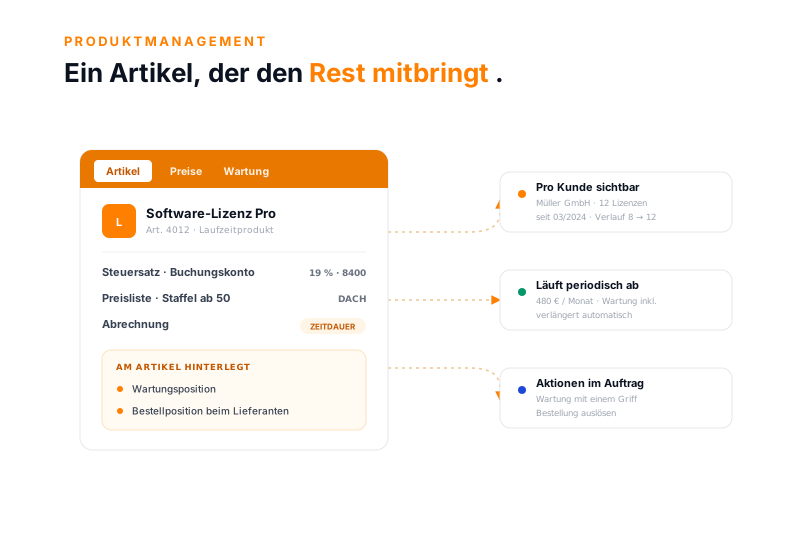
From the orders teamspace derives who holds which product, since when and at what price. Nobody maintains this list a second time.
Licence management software runs licences, maintenance and managed services as duration products, with no stock to keep. teamspace derives from the orders which client holds which licence, how many and since when, without anyone maintaining the list twice.
Day to day
Professional services firms sell more than hours. Licences, maintenance and managed services are products, just without a shelf. teamspace takes three things in hand for them.
Strength 1
From the orders teamspace derives who holds which product, since when and at what price. Nobody maintains this list a second time.
Strength 2
Licences, subscriptions and maintenance pile up nowhere. They run as duration products and bill on the cycle you set.
Strength 3
The maintenance line and the supplier order are held on the item. In the order they stand ready at a single touch.
The overview
Licences are rarely bought all at once. They grow across many quotes and orders, some come in, some fall away. Anyone who then wants to know how many a client holds today is searching through a heap of separate documents.
A product brings these line items together, whatever document they come from, and shows the state at any point in time.
Anyone reselling licences on to their own clients can pull the whole list per client here: which products, how many, at what average monthly price. For managed support, the revenue per product is shown in the same way.
A product in teamspace is more than a price. Whatever is set up once on the item turns up again in the order by itself.
Einmal am Artikel gepflegt, steht im Auftrag mit einem Griff bereit.
More than a catalogue
A product need not be a catalogue entry. It can represent a single instance, for example a particular company car or one device. All documents for it then gather in one place.
That way the product master becomes a tool that can do more than count licences.
“Time tracking is far simpler and more convenient than in Excel.”

No obligation
How are your products structured?
We look at your product structure: which licences, maintenance and duration contracts come together, and on what cycle they bill.
Prices
The prices hang on the item, not in a separate table. teamspace keeps a price list per client, with tiered rates and volume discounts.
That keeps the price consistent, from the price list through the quote to the invoice.
Measure success
Because the product data arises from the orders, teamspace answers the questions a catalogue cannot: what does a product bring in, and where is a contract running out?
Per product
visible across all clients
Licence count over time
traceable up and down
Visible before expiry
through the order filter
Renewal
as long as not cancelled
Setting up
Setting up every product fully by hand costs time. With templates the defaults are already in place, only the finer points come per product.
Use cases
A product rarely stands alone. It runs through quote, order and invoice, and shares the same line items and prices with them.
Products sit as line items on the order, the status runs along day by day.
Learn moreFrom billable line items the invoice is made in one click.
Learn moreProducts from the item master land in the quote with price and tier.
Learn moreFollow open quotes systematically, with a reminder on the due date.
Learn moreOpen receivables climb in several stages, each stage with its own deadline.
Learn moreLicences and maintenance run as a contract that bills itself each period.
Learn moreScope of functions
Part of the invoicing software
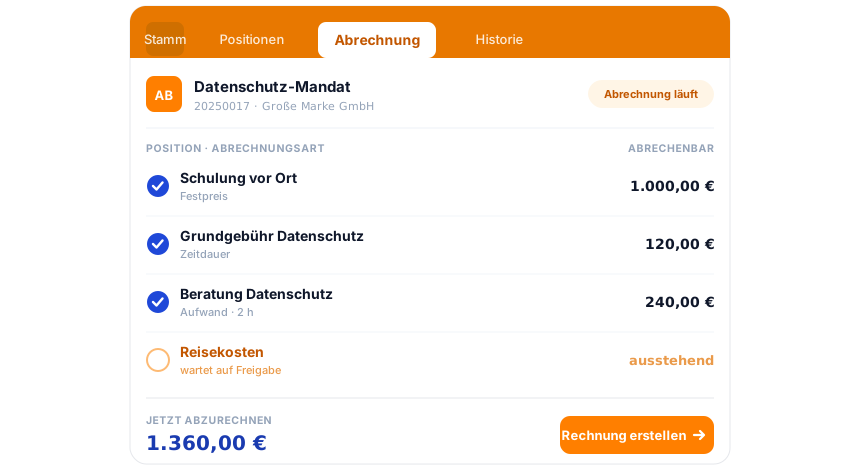
Products become line items in the order, on the order hours, flat rates and travel costs gather until it proposes the finished invoice. Quote, dunning, e-invoicing and the DATEV booking-data service all run in the same system. How it all fits together is shown in the invoicing software overview.
To the invoicing softwareWhat it is about
Licence management software runs the services a professional services firm sells as duration products with master data, prices and contract terms: software licences, managed services, maintenance packages, hardware and training. Unlike in retail, it needs no stock management, because these products pile up nowhere. Many of them are duration products, delivered continuously and billed periodically.
The benefit shows in day-to-day work: because the product data arises from the orders, you see per client who holds which product, at what price and how long the contract still runs. Prices come from the price list with tiers and discounts, ongoing contracts bill through recurring invoices, and the renewal business is carried forward by the CRM as a sales opportunity.
We have been developing teamspace since 1999 in Darmstadt. Operations run in an ISO 27001 certified data centre in Frankfurt am Main, with data processing exclusively in the EU. The contracting party is 5 POINT AG, a German public limited company under German law.
Related modules
A product arises in the order, gets billed and is followed up in the contact. Three modules access it directly.
Hours booked on maintenance and service are the basis of every effort line. Booking and billing run on the same employee.
From the order the project arises with budget, phases and team. Effort and flat rates flow back into the invoice.
Organisation, contact and activity record who uses which product. The renewal becomes the sales opportunity.
First call
We open up together how your licences, maintenance and duration contracts run, and where teamspace takes the duplicate upkeep out.