
Objective
- The actual times are recorded, not an estimate at the end of the month.
- Start, end and duration are captured when clocking in, not from memory.
- The system factors in breaks according to the rules configured.
Since the Federal Labour Court ruling of September 2022, every employer in Germany must record the start, end and duration of working time. A planned law additionally mandates the electronic form. We set out what applies, what is coming and who is affected.
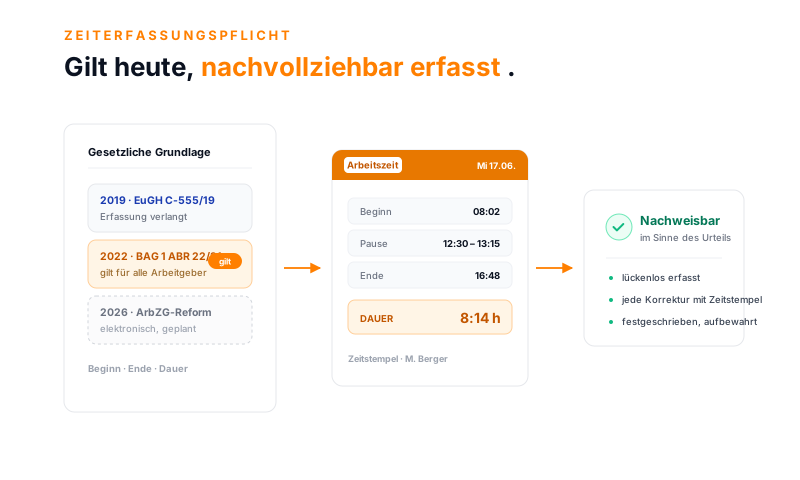
Legal status
Many companies are waiting for a law. Yet the obligation to record working time has long applied, established by Germany's highest labour court.
Member states must require recording
The Court of Justice rules that employers need an objective, reliable, accessible system to measure daily working time.
The duty applies to every employer
Under § 3 (2) no. 1 ArbSchG, read in line with the ECJ, German employers must already record working time.
Record start, end and duration
Beginning, end and total of the daily working time have to be captured for the whole workforce.
Electronic recording, planned
A planned amendment makes electronic recording mandatory, with transition periods staggered by company size.
The duty is not coming, it is here. What changes in 2026 is the form, not the obligation.
What applies
A time-tracking obligation is the employer's legal duty to record their employees' working time: when it begins, when it ends and how long it lasts.
In Germany this obligation does not wait for a new law. The Federal Labour Court ruled on 13 September 2022 (case reference 1 ABR 22/21) that employers must already introduce a system to record total working time. The basis is section 3(2) no. 1 of the Occupational Health and Safety Act (Arbeitsschutzgesetz), interpreted in the spirit of the ECJ ruling C-555/19 from 2019.
What must be recorded is the start, end and duration of daily working time, for the entire workforce. How a company implements this is not prescribed by the court. What matters is that the record is created objectively and reliably. An Excel cell that can be overwritten without trace does not meet this standard.
Requirements
The European Court of Justice names three properties that a working-time recording system must have.
“Time tracking is far simpler and more convenient than in Excel.”

Industries
Regardless of the general recording obligation, some industries have had to document more strictly for years. Section 17 of the Minimum Wage Act (Mindestlohngesetz) requires the economic sectors named in the Act on Combating Illegal Employment to record the start, end and duration of daily working time. The record must be available within seven days and kept for two years.
These include, among others:
The same obligation applies to marginally employed staff (minijobs) and to companies that hire out or post workers. Anyone who fails to keep proper records here risks a fine of up to 30,000 euros under section 21 of the Minimum Wage Act.
In figures
What the time-tracking obligation means in practice can be read from a few figures, from the landmark ruling to the range of fines.
ECJ ruling
Landmark decision on working-time recording (C-555/19)
applies to all
Federal Labour Court decision 1 ABR 22/21 of 13 September
fine of up to
under section 21 MiLoG in the affected industries
deadline to record
in the industries under section 17 of the Minimum Wage Act
In practice
The biggest worry in the debate about the obligation is not whether, but how. Associations from the construction and building-cleaning sectors point to their distributed work: employees are spread across building sites and premises, so a fixed terminal at the entrance is of little help to them.
This is exactly where cloud-based time tracking comes in. Recording happens in the way that suits the workplace: in the browser at the desk, through the installable web app while out and about, or on a tablet that serves as a clocking terminal at the entrance. The place of work is captured through categories, for example office, home office or external work.
Data protection can be maintained too. Instead of requiring private mobile phones, recording runs through the company application. And anyone working with trust-based working time keeps the flexibility: what is recorded is the time worked, not a rigid schedule.
Intro call
Unsure whether your current solution meets the requirements? In 15 to 30 minutes we look at your recording setup together and tell you where you stand.
With teamspace
Every entry is recorded with the person and a timestamp.
Browser, installable web app or a tablet as a clocking terminal.
Corrections stay visible, and locking seals the checked times.
More use cases
Once working time is recorded cleanly, it turns into records, invoices and reports, all in the same system.
Hours on project, phase and task, split into billable or internal.
Learn moreAn hours record per engagement as a PDF at the click of a button.
Learn moreBooked times assemble themselves for approval and are then locked.
Learn moreTarget vs. actual live, premiums by agreement, payout or time off in lieu.
Learn moreRequest and approve absences and offset them in the time account.
Learn moreClock in and out at the terminal, in the app or in the browser.
Learn more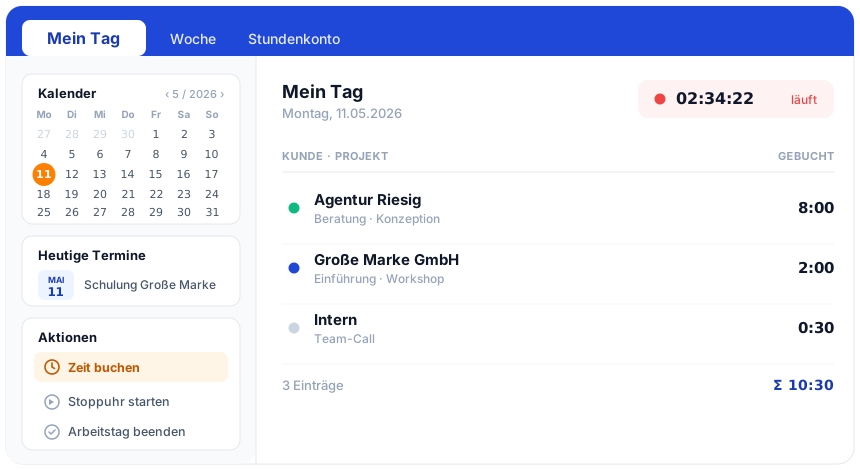
Part of time tracking online
Attendance and project times, timesheets, activity records and absences all run in the same system. A single record feeds the time account, the project report and payroll preparation at once. The overview page shows how the whole module fits together.
Go to time tracking onlineOutlook
The planned law reforming the Working Hours Act (Arbeitszeitgesetz) will make electronic recording binding. Under the ministerial draft from the Federal Ministry of Labour, employers are to record the start, end and duration of daily working time electronically on the day the work is performed. Exemptions and transition periods staggered by company size are envisaged for small businesses.
A firm date for entry into force has not yet been set. The direction is clear. Anyone already recording working time digitally and traceably today will not have to change anything on the cut-off date. A spreadsheet that someone adds up at the end of the month meets neither today's nor the coming requirement.
The pragmatic path runs through three steps: switch daily recording to a system that captures start, end and duration automatically; document corrections with the person and a timestamp; and lock approved times so the record can no longer be changed.
This article gives an overview as at June 2026 and is no substitute for legal advice. In case of doubt, employment-law advice will clarify the exact scope of your obligations.
Related modules
Recorded working time turns into project metrics, invoices and payroll data, without anyone retyping a thing.
Booked hours land on project and phase and drive plan vs. actual, contribution margin and utilisation.
Approved hours become the basis for invoices without any export, with hourly rates, flat rates and travel expenses.
Hours, overtime and absences flow to the payroll office ready-prepared, without double entry.
We look at your current recording setup, your industry and your interfaces to payroll and invoicing. Afterwards you know what the obligation means for your business and what a digital route looks like.