
1
Completeness
Delivered work must be fully captured or billable hours are quietly lost. Realisation rate is the leading KPI.
In many professional services firms the billing process holds the biggest quick win. Complete time capture, clear billing rules, short cycle time and a reliable forecast improve revenue, margin and liquidity at the same time.
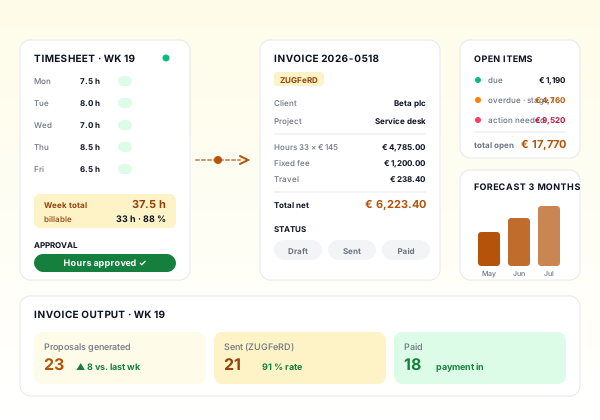
Delivered work must be fully captured or billable hours are quietly lost. Realisation rate is the leading KPI.
Shorter cycle time means better liquidity. Target: days, not weeks, between work and invoice.
Open projects and booked hours create a revenue forecast that lifts planning confidence dramatically.
Hours, fixed fees, materials and travel cost are booked on the project promptly, ideally daily, weekly at the latest.
Managers review and approve hours before invoicing. Disputed entries return with a comment.
Approved work and billing rules produce an invoice proposal per client, project or contract.
Project lead or finance reviews the invoice and sends it as PDF, ZUGFeRD or XRechnung to the client or portal.
Open receivables flow through automated dunning stages. Incoming payments reconcile automatically and close open items.
Forecast, margin per client, realisation rate and cycle time flow into the management dashboard.
Sum of invoices issued per period. Core performance metric, split by client, project and service.
Time from work to invoice. Shorter is better for liquidity. Green: below 14 days, red: above 30 days.
Billable hours over total hours. Exposes hidden project losses.
Expected revenue from open projects, contracts and pipeline. Green: at least 90 percent predictable.
Average time from invoice to payment. Directly hits cashflow and liquidity.
Share of electronically sent and machine-processable invoices. Mandatory for B2G and from 2025/2026 standard in B2B.
Automation
The decisive jump in billing sits between Level 2 and Level 4. Instead of copying hours from a time list into an invoice form, teamspace turns approved work into an invoice proposal that finance only reviews and sends.
Approved project hours, fixed fees and travel cost flow into the invoice proposal. No CSV export, no double entry.
Invoices are created hybrid (PDF + XML). B2G obligations and B2B requirements are covered out of the box.
Posting records are exported to accounting, including cost centres and tax codes.
Invoices issued ad hoc, often at quarter end. Completeness of work capture cannot be verified.
Invoices created in Word or spreadsheets, hours collected separately. High manual effort.
Invoicing software in use, time capture separate, manual transfer of line items.
Hours and projects as billing source, invoice proposal with review. ZUGFeRD/XRechnung available.
Automated invoice creation by rules, forecast, multi-stage dunning, DATEV export.
Real-time invoicing, automated dunning, automated reconciliation, integrated forecast through to liquidity.
| Feature | Classic (billing tool + spreadsheets) | teamspace billing process |
|---|---|---|
| Work capture | Hours in spreadsheets, consolidated manually | Hours, fees and expenses at the project, approved |
| Invoice creation | Manually per invoice, high error rate | Invoice proposal from project data, review instead of typing |
| E-invoicing | Separate tools, often only PDF | ZUGFeRD and XRechnung as standard, B2G covered |
| Dunning | Manual from memory, often too late | Automated stages with custom text |
| Forecast | Gut feel | Forecast from open projects and pipeline |
| DATEV handover | CSV, manual | Automatic export with cost centres and tax codes |
Quotes, orders, invoices, dunning, with all B2B standards.
Learn moreRecurring invoices, subscriptions, fixed fees, contracts and mixed models.
Learn moreCreate, validate and send ZUGFeRD and XRechnung, B2G compliant.
Learn moreMulti-stage dunning with configurable text and escalation.
Learn moreOrders with billing rules, partial invoices, final invoice, advance payments.
Learn morePosting records and invoices to accounting, including cost centres.
Learn moreIn many professional services firms billing is surprisingly inefficient. Work is not captured completely, invoices are issued late, revenue forecasts are vague. The immediate consequence: liquidity is tied up unnecessarily, billable work is quietly lost, and management has no reliable view on upcoming revenue.
An automated billing process delivers complete work capture, faster invoicing and precise revenue forecasts. The impact is direct on cashflow and margin, without winning a single new client.
Maturity is not the brand of your invoicing software. It comes down to four points: is all work captured, is it approved and invoiced within a week, are receivables dunned and reconciled automatically, is there a forecast management trusts?
If multiple answers are ‘rather no’, you are typically on Level 1 or 2. The jump to Level 3 or 4 is often the fastest visible value an integrated steering system delivers.
A high-maturity billing process is fast, complete and predictable. Hours are current, invoices come out of project data, ZUGFeRD and XRechnung are standard, dunning runs automatically and forecast is a core figure in business steering. Administration becomes lived liquidity steering.
In a 15 to 30 minute requirements call we score your billing process against the maturity model and outline the biggest concrete lever.