
1
Fixed costs
People, rent, software, other running costs. Move slowly month to month, but are the basis of every profitability analysis.
In professional services firms costs spread across many projects and departments. teamspace connects fixed costs, project costs, contribution margins and liquidity planning in one view, with early warning instead of quarter-end shock.
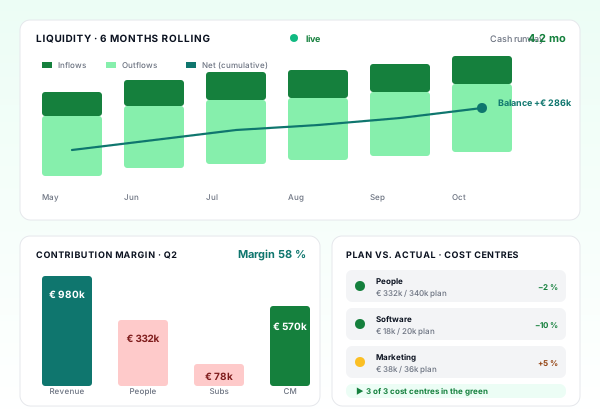
People, rent, software, other running costs. Move slowly month to month, but are the basis of every profitability analysis.
Costs directly attributable to a project: hours, materials, travel, subcontractors. Drive contribution margin.
Cashflow as inflows minus outflows, planned over months. Reveals bottlenecks before they hit.
Annual planning of fixed costs, staff costs, investments and variable project costs. Distributed across months and cost centres.
Incoming invoices, travel cost, expenses and hours are booked directly to the project or cost centre, ideally digitally.
Planned vs. actual cost per period and cost centre. Deviations are scored with thresholds.
Project revenue minus direct project cost equals contribution margin. Aggregated per client, service and business area.
Planned inflows minus planned outflows, rolling 3 to 12 months. Early warning on upcoming bottlenecks.
Deviations trigger concrete actions (dunning, investment shift, sales focus). Forecast is continuously updated.
Sum of project contribution margins per period. Tells you what remains after direct project cost.
Contribution margin divided by number of projects. Shows the quality of the project portfolio.
Classic profitability KPIs with breakdown by cost type and business area.
Are we financially stable? Green: 2 to 6 months of fixed costs covered, red: below 1 month.
Average time from invoice to payment. Directly hits liquidity.
How well do we hit our cost plan? Thresholds per cost type, individually configurable.
Liquidity
Most liquidity issues do not erupt suddenly, they build over weeks. A rolling liquidity plan over three to twelve months exposes the trend early, before the bank balance gets tight.
Expected payments from open invoices, contracts and pipeline. With DSO as smoothing factor.
People, rent, software, tax, investments. From the cost plan, plus one-offs.
Weekly balance, cumulative. Warning when a bottleneck looms, with lead time for counter measures.
No systematic cost planning. Profitability surfaces once a year at the accountant.
Cost plan in spreadsheets, plan/actual after year end. No multi-month liquidity planning.
Cost types, cost centres and plan/actual defined. Data from accounting and spreadsheets is merged manually.
Controlling system with monthly plan/actual. First contribution margin reports.
Live plan/actual, automatic contribution margin per project and client, rolling liquidity plan.
Real-time profitability, 12-month forecast, early warning with suggested actions, integrated investment planning.
| Feature | Classic (accounting + spreadsheets) | teamspace cost control |
|---|---|---|
| Cost capture | In accounting, delayed by weeks | At project and cost centre, daily |
| Contribution margin | Annual or not reported | Live per project, client, service and area |
| Liquidity planning | Bank balance, guess for next weeks | Rolling 3 to 12 months with forecast |
| Plan/actual | Quarterly from spreadsheets | Monthly or weekly, automatic with thresholds |
| Early warning | Manual, often too late | Thresholds with action suggestions |
Digital capture and approval, with project and cost centre assignment.
Learn moreReceipt approval, OCR, cost centre, handover to DATEV.
Learn moreTrips, expenses, receipts per project. Handover to billing and payroll.
Learn morePlan/actual, margin, early warning per project and client.
Learn morePosting records, cost centres and tax codes to accounting.
Learn moreReceivables and dunning, basis for DSO and liquidity.
Learn moreUnlike manufacturing, cost in services is largely people-related and spreads across many projects. Traditional accounting groups by cost type and delivers quarterly numbers with delay. For operational steering that is too slow and too coarse.
A structured cost control process connects cost planning, project-level cost capture, contribution margin calculation and liquidity planning in one data model. Profitability becomes a continuous management view, not a year-end revelation.
Score honestly using four questions: are costs fully distributed across projects and cost centres, are plan/actual and contribution margin available monthly or more often, is there a liquidity plan covering at least three months, do deviations surface automatically with thresholds?
If the answers are mostly ‘no’ or ‘partially’, you are typically on Level 1 or 2. The jump to Level 3 or 4 usually pays off in two areas: fewer quarter-end surprises and sharper investment decisions.
A high-maturity cost control process turns profitability and liquidity into daily figures, not annual reviews. Leadership sees margin per project, cashflow over the coming months and plan/actual variance per cost centre, on the same data set operations produces. Cost control shifts from reporting to actual business leadership.
In a 15 to 30 minute requirements call we score your cost control process against the maturity model and pinpoint the largest current risk.