
1
Early warning, not retrospective
Project trouble shows up before it escalates, not in the post mortem. Plan/actual and earned value update daily.
Delivery is the heart of every professional services firm. teamspace connects planning, resourcing, plan/actual comparison, earned value and project margin in a single view, with early warning instead of after-the-fact reporting.
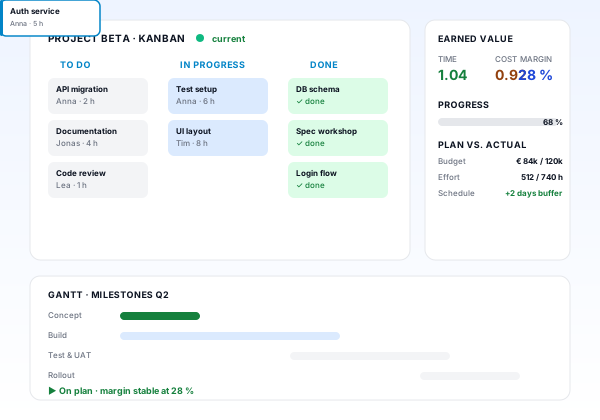
Three properties separate professional delivery steering from a simple task list.
Project trouble shows up before it escalates, not in the post mortem. Plan/actual and earned value update daily.
Who is doing what, with which capacity, until when? Resource planning is the planning basis, not a report.
Projects are steered by profitability, not just progress. Margin per project, per client, per project lead.
Delivery runs along a clearly defined path, from handover out of sales to project close.
Won opportunity becomes a project with budget, team, template and billing model. No media break.
Work breakdown, milestones, tasks, dates and budgets are defined. Templates accelerate similar projects.
People are assigned to tasks, capacity is reserved, conflicts surface. Utilisation is steered ahead, not afterwards.
Hours are booked on tasks, effort and progress flow together daily. Plan/actual and earned value expose deviations early.
Based on early signals, dates, budgets or scope are adjusted with documented reasoning and transparent communication.
Remaining work is billed, learnings feed into future templates, the project is closed with a plan/actual summary.
Few but precise KPIs, each with thresholds and a clear meaning.
Project revenue minus project cost, or margin in percent. Green: 15 to 30 percent, industry dependent. Shows which projects carry the firm.
Billable hours over total hours. When it drops, hidden project losses appear.
Delivered progress as monetary value. Compares actual delivery to planned cost and actual effort.
Consumed budget against progress. Green: in line. Red: consumption clearly ahead of progress.
Delay against plan in days or percent. Rising variance calls for escalation or replanning.
Utilisation of assigned staff over project duration. Green target: 70 to 85 percent.
Earned value
Earned value compares planned value (PV), earned value (EV) and actual cost (AC). It yields schedule (SPI) and cost (CPI) indices. The method sounds complex, but teamspace computes it automatically once plan, progress and hours are maintained.
Project moves faster than planned. Often valuable because it creates buffer.
Project is slower than planned. Escalate, replan or add resources.
Project costs more than planned. Margin at risk, act immediately.
Which level describes your delivery steering most honestly today?
Projects run ad hoc. No plan, no baseline, no analysis. Success rides on the project lead.
Projects planned in spreadsheets or MS Project, hours captured separately. Analysis is laborious.
Phases, milestones and tasks are recorded systematically. Data sources are not connected.
Project management software in use. Plan, resources and hours in one system. First plan/actual analysis.
Earned value, margin and early warning run automatically. Utilisation and forecast update daily.
Real-time steering with prompts, automatic escalation, suggested actions and forecast through to liquidity.
| Feature | Classic (PM tool + spreadsheets) | teamspace delivery process |
|---|---|---|
| Data model | Plan in MS Project, hours separate, billing in a third system | Plan, hours, effort, billing in one data model |
| Plan/actual | Assembled manually, often weeks old | Up to date and automatic, daily |
| Early warning | Escalation surfaces late, often through client complaint | SPI, CPI and utilisation variance with thresholds |
| Resource planning | On the side in a spreadsheet, unrelated to project plan | On the task model, with capacity check |
| Handover to billing | Export time list, push manually into billing | Invoice proposal generated from project data, review and send |
Planning, tasks, milestones, boards. The central steering space.
Learn morePlan/actual, margin, early signals, escalation.
Learn moreAutomatic SPI and CPI on your data.
Learn moreResources across projects, with utilisation and conflict detection.
Learn morePortfolio view, prioritisation, resource allocation across projects.
Learn moreHours on project and task, with direct handover to billing and reporting.
Learn moreIn professional services value is created in delivery. Deadlines are met, hours are booked, margin is earned or burned. Yet delivery is often the weakest steered process. Typical symptoms: ‘we only know after closing whether the project was profitable’ or ‘resource planning sits in a spreadsheet because the project tool cannot do it’.
A professionally steered delivery process enables early problem detection, better resourcing and higher project profitability. Above all it is the precondition for clean billing and reliable numbers in business steering.
Maturity is not the project tool you run. It is the connection of plan, resources, hours, effort and margin in one data model. A project tool without integrated time capture is Level 2. An integrated system with plan/actual and analysis reaches Level 3. Only when earned value, utilisation and margin run automatically are you at Level 4.
The honest assessment uses four questions: are all projects fully managed, are plan and effort current, are plan, hours, resources and margin in one system, does the system support actively with early warning and forecast?
A high-maturity delivery process steers projects by impact, not by activity. Margin is the leading KPI, earned value provides early warning, resource planning prevents bottlenecks and reporting runs automatically. Delivery becomes something you consciously steer instead of merely running.
In a 15 to 30 minute requirements call we score your delivery process against the maturity model and outline the next realistic step.