
1
Pipeline steering (future)
How many opportunities sit in which stage? What revenue is potentially expected? How does the pipeline evolve over time? Focus: future revenue.
Sales largely defines the future trajectory of a professional services firm. teamspace combines pipeline, activities, clients, campaigns and forecast in one view, with clear thresholds and a measurable maturity.
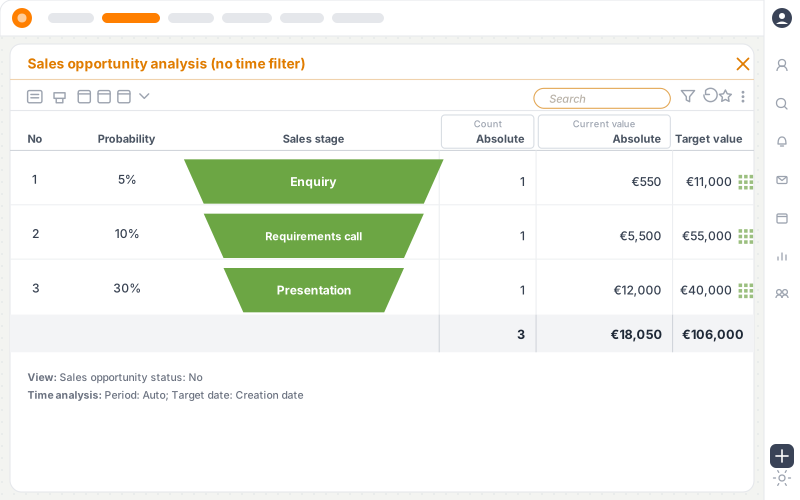
An effective sales dashboard combines pipeline, deal quality and activities. Each dimension answers a different question, together they form a complete picture.
How many opportunities sit in which stage? What revenue is potentially expected? How does the pipeline evolve over time? Focus: future revenue.
How many enquiries become engagements? How high is the close rate? How are campaigns performing? Focus: efficiency of sales.
How active are salespeople? When was the last touch on key VIPs? How are key accounts looked after? Focus: relationship quality.
Steering happens through opportunities with a defined stage, a monetary value, an owner and a client. They are organised in a pipeline funnel.
Incoming enquiry from campaign, referral or proactive outreach. Fully recorded in CRM with source, contact and need.
Assess budget, decision maker, need and timing. The enquiry becomes a scored opportunity with size, probability and ownership.
Proposal generated from CRM with versioning and status. Proposals stay linked to the opportunity, effort and margin calculation are traceable.
Meetings, queries and adjustments are logged as activities. Reminders prevent negotiations from drifting away.
A won opportunity becomes a project or engagement in one click. Data flows into delivery without media break.
ABC client classification
Automated ABC classification rates every client continuously against custom criteria such as revenue over the last 180 days, contribution margin, strategic importance and development potential. The class is visible everywhere it matters: in emails, tickets, calls, projects and CRM.
Proactive care, fast response, top priority on tight resources. Surfaced everywhere instantly.
Solid base, targeted growth activities, structured contact frequency.
Efficient handling, standardised flows, no overinvestment.
Eight KPIs cover pipeline, efficiency, activities and relationship quality. Each one has thresholds you configure for your business.
Sum of open opportunities, optionally weighted. Green target: at least three times monthly revenue, red below two.
Won deals per period. Green at or above 120 percent of revenue target. Leading indicator for growth and buffer.
Ratio of opportunities to wins. Green above 30 percent, amber between 15 and 30 percent, red below.
Time from lead to close. Stable or short values are green, fast-growing cycle time is a frequent early warning for pipeline congestion.
Share of open opportunities without a planned next activity. Green below 10 percent, red above 25 percent. The single most important leading indicator.
Number of logged sales activities per rep per period. Tells you: is your team selling, or just administering?
Days since the last logged touch on key contacts. Green below 30 days, red above 60 days.
Marketing performance with close rate and ROI. Flags ineffective campaigns immediately.
Thresholds and signals
Showing KPIs alone is not enough for effective steering. Only an explicit rating exposes where action is needed. Every key KPI in the sales dashboard carries a threshold with values you define.
No action required, regular monitoring.
Attention needed, root cause analysis.
Escalation, clear measure, owner and due date.
Not every firm has the same structure and automation. Maturity shows how systematically sales is actually steered.
No structured sales process. Leads tracked unsystematically. No central pipeline view.
First structure in spreadsheets. Opportunities partly documented, not consistently maintained.
Sales process with stages and pipeline defined. Opportunities recorded systematically, but without integration.
CRM in use. Pipeline, activities and proposals managed with system support. First reports and forecasts.
Automated reports, forecasts and reminders. Activities, campaigns and ABC classification integrated.
End-to-end steering: automated prioritisation, intelligent prompts, integrated flow from sales through project to billing, real-time dashboards.
The decisive difference sits in the data model and in activity steering.
| Feature | Classic (CRM + spreadsheets) | teamspace sales process |
|---|---|---|
| Pipeline | Exported to spreadsheet, consolidated manually, often a week old | Live in the system, sorted by stage, value and owner |
| Forecast | Gut feel, spreadsheet estimate, varies by person | Weighted pipeline, conversion data, plan-actual comparison |
| Activities | In Outlook and notebooks, no link to opportunities | Linked to opportunity, client, VIP and campaign, fully logged |
| Client value | Gut feel, not visible across the system | ABC classification in CRM, email, ticket, project, call |
| Campaign ROI | Rarely measured, attribution unclear | Revenue and close rate per campaign, ROI automatic |
| Handover to delivery | Manual switch to project tool, double entry | Won opportunity becomes a project with budget and team in one click |
Cross-cutting functions
Beyond sales-specific functions, cross-cutting building blocks contribute meaningfully to steering. They yield additional KPIs like sales effort per opportunity, acquisition cost per win or marketing ROI on a real cost basis.
Client meetings, proposal prep, internal alignment and communication effort are linked to opportunities. From that we get effort per opportunity, effort per win and marketing ROI with real numbers.
Client visits, on-site presentations and acquisition trips are linked to opportunities or clients. Actual acquisition cost becomes transparent and comparable.
Reminders, proposal follow-up and reactivation prevent opportunities from drifting. The KPI 'opportunities without next activity' is the most important early warning.
The sales process is supported by an integrated module set, all on one shared data model.
Clients, contacts, VIP structures, history. Foundation for every activity.
Learn morePipeline steering with stage, value, owner and campaign. The central steering object.
Learn moreProposal creation with versioning, status and transition to engagement.
Learn moreTouches, reminders and follow-ups. Relationship steering in one view.
Learn moreLead sources, ROI per campaign, conversion through the funnel.
Learn moreForecasts, pipeline reports and dashboard with thresholds.
Learn moreSales largely defines the future trajectory of a professional services firm. At the same time it suffers from exactly the problems a steering system is meant to solve: incomplete pipeline, unreliable forecasts, missing activity steering, opaque client value. Typical symptoms: ‘we only know at quarter end where we stand’ or ‘half our A clients have not been contacted in three months’.
A structured sales process enables realistic revenue forecasts, better client prioritisation and targeted market work. Above all it makes sales performance scalable and independent of individuals. That is the step that unlocks predictable growth.
Many firms overestimate their maturity. Common errors: ‘we have a CRM, so we are advanced’, ‘our data exists, even if it is not consistently maintained’, ‘our seniors have the overview’ or ‘we run reports, so we steer sales’. These assumptions hide structural gaps.
An honest assessment uses four questions:
If multiple answers are ‘rather no’, you are likely one level below your initial guess.
A high-maturity sales process is one where every opportunity is current and complete, activities are steered consistently, clients are prioritised by value, KPIs and forecasts are available at any time and leadership decides on current data.
Maturity is not the software in place but the quality of data, the consistency of use and the ability to derive concrete decisions. Firms that develop sales systematically lay the foundation for predictable growth, higher efficiency and sustainable evolution.
Sales is just one of seven core processes. The other six:
How do we deliver projects reliably, on time and profitably?
How do we convert work into revenue completely and quickly?
How do we keep costs and liquidity under control at all times?
How do we serve clients by value, with high quality?
How do we steer capacity, skills and motivation optimally?
How do we lead the firm on current data?
In a 15 to 30 minute requirements call we score your sales process against the maturity model and outline a realistic path to the next level.