
What? The cost type
What kind of cost or revenue arose: personnel costs, travel, external services, licences, fee income.
Cost and performance accounting is a company's internal accounting. It answers one question: what do we actually make money on, and what not? teamspace covers all of it, secondary costs, allocations and reallocations included, and most of it runs automatically.
What is cost and performance accounting?
Cost and performance accounting, often simply called cost accounting, assigns every euro to three questions: what was spent (cost type), where it arose (cost centre) and what it was for (cost object). It sets the costs against what the firm produced, which for a service business mostly means hours sold. The result is a contribution margin per project, per client and per department. Financial accounting has a different job: it serves the tax office and the balance sheet, and it looks at the company as a whole.
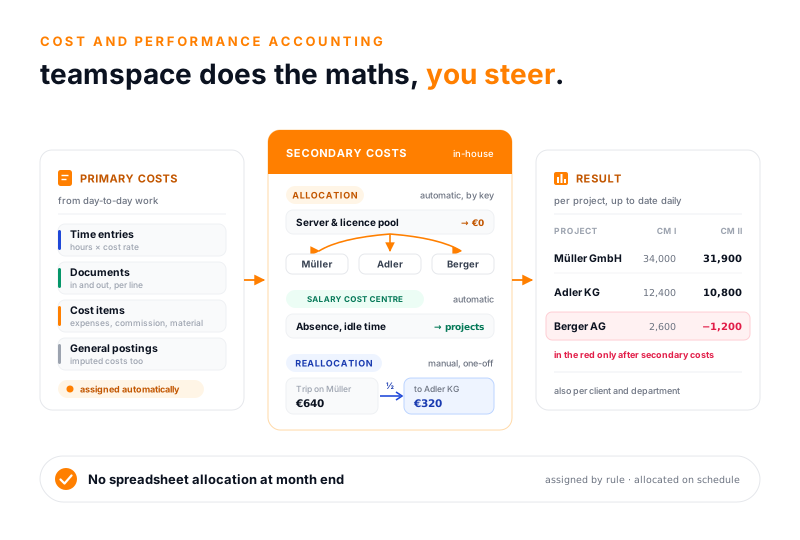
Cost accounting that stops at the individual project only tells half the story, though. IT, administration, servers and licences have to be paid for too, salaries keep running during holidays, and a trip covering two clients is hardly ever split correctly in the system. That is why teamspace covers the whole of cost and performance accounting, secondary costs included: automatic allocations by allocation key, a salary cost centre for personnel costs and manual reallocations for one-off cases. Contribution margin II shows what is left once all of that has been distributed.
Doing this by hand takes an enormous amount of work: exporting hours from time tracking, assigning supplier invoices, spreading overheads across a spreadsheet by key, reconciling everything at the end, and doing it all again next month. In teamspace almost all of it happens automatically. A rule sets cost type, cost centre and cost object as soon as something is booked, allocations run on a fixed schedule, and the contribution margin is up to date every day. You can focus on what the figures are actually for.
Where things stand
Yet the data you need for steering is already there. Who worked is in the time entries, what was spent is on the expenses and supplier invoices, what was billed is on the invoices. In teamspace it is all created in the same system that analyses it. Cost and performance accounting puts this data together in business terms, with no interface and no time lag.
What, where, what for
Take a hotel bill of 180 euros: cost type Travel, cost centre Consulting because that is where the consultant is employed, and cost object P-2026-018 Restructuring Müller GmbH because that is the project she travelled for.
What kind of cost or revenue arose: personnel costs, travel, external services, licences, fee income.
Which area of responsibility the amount arose in: consulting, development, marketing or administration. In teamspace, cost centres form a tree, and postings go to the leaves.
Which piece of work the amount arose for. For a service firm that is almost always a project or a contract, a one-off every time. Several projects can share the same cost object, for example all sub-projects of a framework agreement.
No extra work
Cost type, cost centre and cost object are pre-filled when an entry is made. Nobody has to pick them, but anyone with the right permission can override them. The effort comes once, when the master data is set up.
Cost item · Travel costs
Booked · 480.00 € · expense type set
Travel costs
Sales
Müller project
One rule per element type decides the assignment, set automatically on every element, not coded by hand.
Where the data comes from
Everything in teamspace that creates costs or revenue comes from exactly one of four sources. Each has its own cost and performance accounting section.
The rule is an order of precedence: the first source with a value wins. For project times, for example, the cost centre comes from the employee first and from the project as a fallback, while the cost type comes from the category. For invoice lines the item supplies cost centre and cost type. If a rule finds nothing, the field stays empty, as none of them is mandatory. After a manual change, a click on 'Reset' brings back the rule value.
Classic cost accounting was born in the factory, with unit costs, overhead rates and cost allocation sheets. A service firm does not sell units. It sells the time and skill of its people.
Largest cost block
The product
Unit of measure
Key steering figure
Inventory
Overheads
First call
Let's work through one of your cost centres.
Bring along what you currently split up in Excel: the IT costs, a salary, a trip that covered two clients. In the call you will see how teamspace turns that into cost centres, cost objects and contribution margins.
The principle
Every posting in teamspace carries a cost centre and a cost object. That gives two views of the same money: the department sees all of its costs, the project sees all of its own. Both totals must always show the same real result.
An example with four postings: a licence of 1,000 euros and a trip of 400 euros on cost centre 1, rent of 2,000 euros and revenue of 2,000 euros on cost centre 2. The cost centre view comes to minus 1,400 euros, and so does the cost object view. If one of the totals drifts after a reallocation or an allocation, something has been counted twice or lost.
This leads to a simple rule: movements stay within their view. Reallocations and allocations go from cost centre to cost centre or from cost object to cost object. The only bridge between the two views is the salary cost centre, which holds nothing but salary without a cost object.
A tip from practice: post overheads in full as well. General rent belongs on a cost centre and also on an internal cost object, such as "Administration". If either is missing, the cost centres add up to a different result from the cost objects.
Secondary postings
Primary postings come from outside: times, expenses, documents and postings. Secondary postings arise in-house and move amounts on. teamspace knows three kinds, all using their own cost types in the 9000 class, so every list shows what came from outside and what was distributed internally.
How allocations and the salary cost centre work in detail is covered under cost centre accounting. What they do to the result is shown by contribution margin accounting: CM I works with primary costs, CM II also includes everything distributed internally.
“We mostly work with the budget column.”

In the system
In teamspace, cost centres, cost objects and cost types are not just attributes on a posting but objects in their own right. All three have their own tiles in the cost accounting area and a detail manager with the same tabs.
Tiles, monthly figures and the split by cost type. The cost centre overview puts actual, plan and previous year side by side.
Type, service relationship, owner and weighting. The type decides whether a cost centre carries costs or passes them on.
All primary and secondary postings. For reallocations and allocations, each line shows direction, type and counterpart.
When to distribute, by which key and to which targets. Every cost centre and every cost object has its own rules.
Plan, actual and variance per month and cumulatively, for revenue and costs.
An analysis tile with totals by cost centre, cost object and cost type, by quarter. Each row shows the bridge: CM I plus secondary costs gives CM II.
Plan and actual
Without a plan there is no variance, and without a variance nobody notices in time that something is going off course. In teamspace you plan revenue and costs per month for every cost centre and every cost object. Actuals sit alongside, and the difference is the variance.
The client view comes for free. Through its target project every cost object knows its client, so plan, actual, CM I and CM II are also available per client, including reallocations and allocations.
Where it stops
Financial accounting stays with your tax adviser, and documents go through the certified DATEV interface. Cost and performance accounting runs alongside as the steering view.
Imputed costs
A company car bought for 36,000 euros net is written off over six years for tax purposes, so 6,000 euros a year. In practice it is driven for five years, and a new one would cost 42,000 euros. Cost accounting therefore uses 8,400 euros a year, while financial accounting stays at its 6,000 euros.
In teamspace this becomes a general posting of 700 euros a month on a cost type for imputed depreciation. With a fleet, the vehicles go to a collective cost object that an allocation spreads across the projects. The steering view works with actual consumption, and the bookkeeping does not have to take any of it on.
More in controlling
Cost and performance accounting is the whole system. Each of these pages looks at one part of it.
CM I and CM II per project, client and department, with a worked example.
Learn moreAllocate overheads, the salary cost centre, plan and actual per department.
Learn moreProject, finance, staff and CRM reports with drill-down to the posting.
Learn moreBudget, progress and forecast on the individual project.
Learn morePipeline, forecast and win rate in sales.
Learn moreAssign supplier invoices line by line to a project and a cost type.
Learn more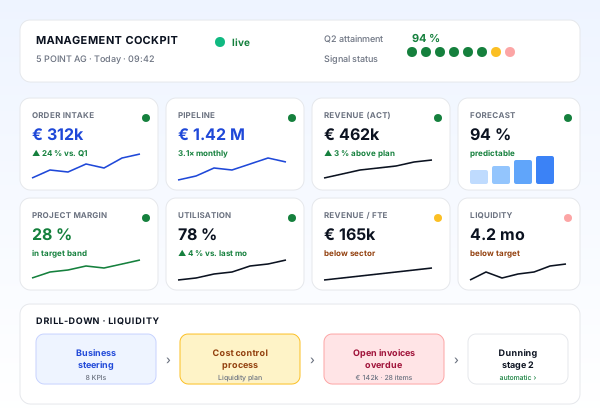
Part of controlling
Cost and performance accounting, contribution margins, cost centres and reports all draw on the same postings in teamspace. How the pieces fit together is shown in the overview of the controlling software.
Go to controlling softwareThe basics
Cost and performance accounting belongs to internal accounting. Unlike financial accounting it is not required by law; a company sets it up according to how it wants to steer. Its purpose is to assign costs to whatever caused them. Only then does it become clear which work pays off and where savings lie.
The formula is simple: output minus costs gives the operating result. In financial accounting the counterpart is income minus expenses equals net profit. Both use the same documents but value some of them differently.
What it is about
Cost and performance accounting assigns every amount to a cost type, a cost centre and a cost object, and so shows where a company works profitably. For service firms that mainly means valuing hours at internal cost rates, spreading overheads across departments and projects, and calculating the contribution margin in stages, from project to client to department. Bills of materials, inventory valuation and the balance sheet are deliberately left out.
Hours and documents are captured in time tracking and the invoicing software, and analysed on the project and in controlling. Cost and performance accounting, including cost centre planning, is part of the office and enterprise editions. Your contracting partner is 5 POINT AG, which has been developing teamspace in Darmstadt since 1999.
Related modules
Costs arise in three modules and reach cost and performance accounting without being transferred by hand.
Hours booked are valued at the internal cost rate and get their cost type the moment they are entered.
The project is the most common cost object, with plan, actual and contribution margin in one place.
Outgoing and incoming invoices carry cost type, cost centre and cost object on every line.
First call
Tell us how you split costs today and which analysis you are missing. In the call we work out which cost centres, cost objects and allocations suit your business.