
Single-stage contribution margin accounting
- Revenue minus variable costs gives the contribution margin
- All fixed costs are deducted as one total
- Quick to calculate, good for a first assessment
- Does not show which department causes the fixed costs
Contribution margin accounting deducts from revenue the costs that a piece of work directly causes. What remains is the contribution margin: the amount that goes towards covering fixed costs and towards profit. teamspace calculates it from hours, expenses and documents, up to date every day, in two stages.
Worked example
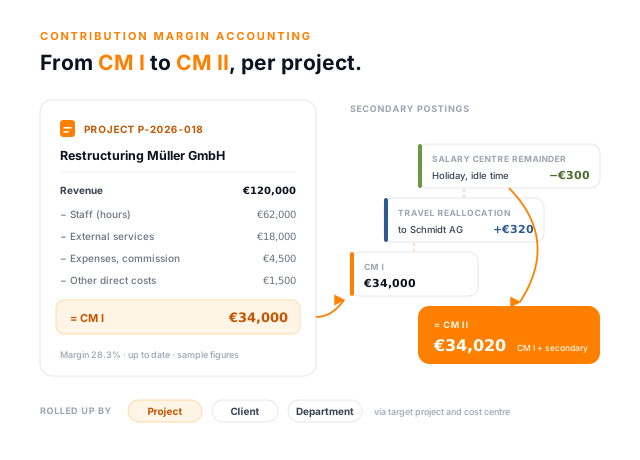
A consulting project for Müller GmbH, project number P-2026-018. In teamspace each line comes from its own source, and the total sits on the project without a month-end close. All amounts are sample figures.
Definition
Contribution margin accounting is a form of marginal costing. Rather than spreading every cost across every piece of work, it deducts from revenue only the costs that this work directly causes. The formula: contribution margin = revenue minus variable or directly attributable costs.
If the contribution margin is positive, the project helps pay for rent, administration and management. If it is negative, the project costs more than it brings in, before a single euro of overhead lands on it. Only when the contribution margins together exceed fixed costs does the company make a profit.
The method emerged between the 1950s and 1970s as an alternative to full costing. The question shifted from 'what does one unit cost?' to 'what does one unit contribute towards fixed costs?'. The second question suits service firms better, because their largest cost block, staff, is fixed anyway.
Single or multi-stage
Single-stage accounting deducts all fixed costs in one block. Multi-stage accounting deducts them layer by layer and shows a separate contribution margin after each stage.
From CM I to CM II
CM I contains every cost booked directly to the project: hours, external services, expenses. For the project lead it is already the most important figure. What is missing are costs distributed in-house. teamspace calls them secondary postings and includes them in CM II.
For the Müller GmbH project, with sample figures, it looks like this. On one trip a consultant also visited Schmidt AG, but the 640 euros of travel costs sat entirely with Müller. A reallocation moves 320 euros to the Schmidt AG project, relieving Müller. At month end, the salary cost centre also distributes what is left over, meaning holiday, sickness and idle time, evenly across the projects. Müller's share is 200 euros.
For a single project the difference is often small. At department level it is larger, because that is where allocations for IT, administration and management land. How a support team at plus 5,000 euros in CM I ends up at minus 2,500 euros after the IT allocation is shown on the cost centre accounting page.
“Staff in both support and project planning can see orders and invoices. That was not possible before.”

In teamspace
teamspace needs no separate calculation run for CM I. Hours come from project time tracking and are valued at the internal cost rate held per employee and period. Invoices, expenses and postings carry their cost object automatically. Open the project and you see today's position.
Figures roll up on three levels:
The 'Cost accounting analysis' tile shows totals by cost centre, cost object and cost type, in total and by quarter. Each row shows the bridge: CM I plus secondary costs gives CM II.
In the help centre: Contribution margin I and II by project, customer and area, using the same project P-2026-018, and Work with the cost accounting analysis.
Where the levers are
First call
Which of your projects really pays its way?
Name a project whose margin you can only estimate. In the call we show how teamspace calculates its contribution margin and which cost rates and rules that requires.
More in controlling
Contribution margin accounting is the results stage. What happens before it is covered here.
Cost type, cost centre and cost object on every posting, pre-filled by rule.
Learn moreAllocate overheads to departments, the salary cost centre.
Learn moreClient analysis with contribution margin and income per hour for each client.
Learn moreBudget, progress and forecast on the individual project.
Learn moreAssign external services to the project line by line.
Learn moreThe process from planning to post-calculation.
Learn more
Part of controlling
Contribution margins, cost centres and reports all calculate from the same postings in teamspace. How project, client and department are analysed together is shown in the overview of the controlling software.
Go to controlling softwareWhat it is about
Contribution margin accounting answers whether a piece of work brings in more than it directly costs. In manufacturing that work is a product; for a service firm it is a project, a maintenance contract or a ticket. The multi-stage form deducts fixed costs stage by stage and shows where the margin is earned and where it is lost.
Two limits come with it. CM I contains no overheads, so a project with a good CM I can still be a burden on the company. And a contribution margin is only as accurate as the cost rates behind it. Anyone who never adjusts internal hourly rates is calculating with an assumption. The salary cost centre shows whether the rates match actual salaries.
In teamspace, contribution margin accounting is part of cost and performance accounting, which is included in the office and enterprise editions. The process from plan to post-calculation is described under cost control. teamspace has been developed by 5 POINT AG in Darmstadt since 1999.
Related modules
Revenue and costs arise in three modules and reach the project without being transferred by hand.
Hours booked become personnel costs on the project at the internal cost rate.
The project is the cost object, with plan, actual and contribution margin in one place.
Outgoing invoices supply the revenue, incoming invoices the external services.
First call
In the call we go through a typical project with you, from cost rates to CM II, and clarify which stages you need for clients and departments.